
FROM MY PT SCHOOL NOTES · FOUNDATIONS OF CLINICAL SKILLS · CHAPTER 11
Which Assistive Device and Gait Pattern Fits the Task?
A device should support safer functional mobility, not simply match a diagnosis.
Match the device to the person
The FCS gait lecture covers parallel bars, standard and rolling walkers, axillary and forearm crutches, hemiwalkers, quad canes and single-point canes. Device selection must balance stability, endurance and cardiopulmonary demand, hand function, upper-extremity weight bearing, cognitive ability, terrain, home setup and the person’s mobility goals.
Weight-bearing terms from class include non-weight-bearing (NWB), toe-touch/touch-down (TTWB/TDWB), partial weight-bearing (PWB), weight-bearing as tolerated (WBAT) and full weight-bearing (FWB). These terms need patient-specific orders, often including exact allowed load or surgical restrictions; do not assume that a generic category fully describes what a patient is permitted to do.
See the equipment: two walking aids
Front-wheel walker
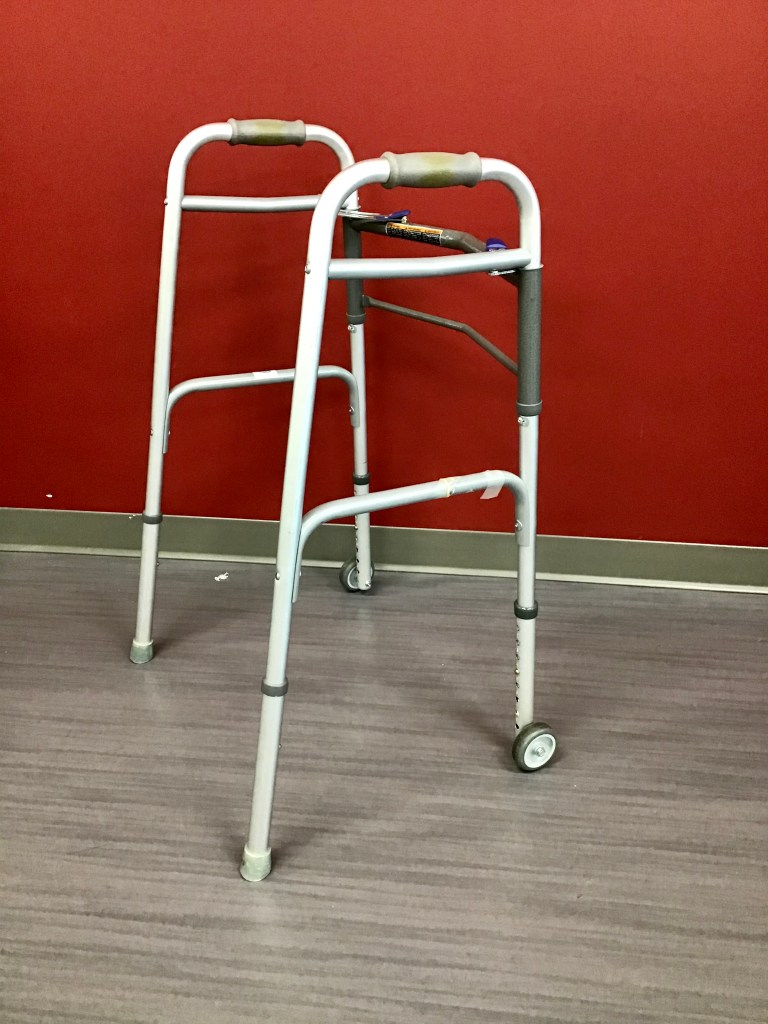
Front wheels with rear rubber tips. Can offer substantial support while needing different handling than a rollator.
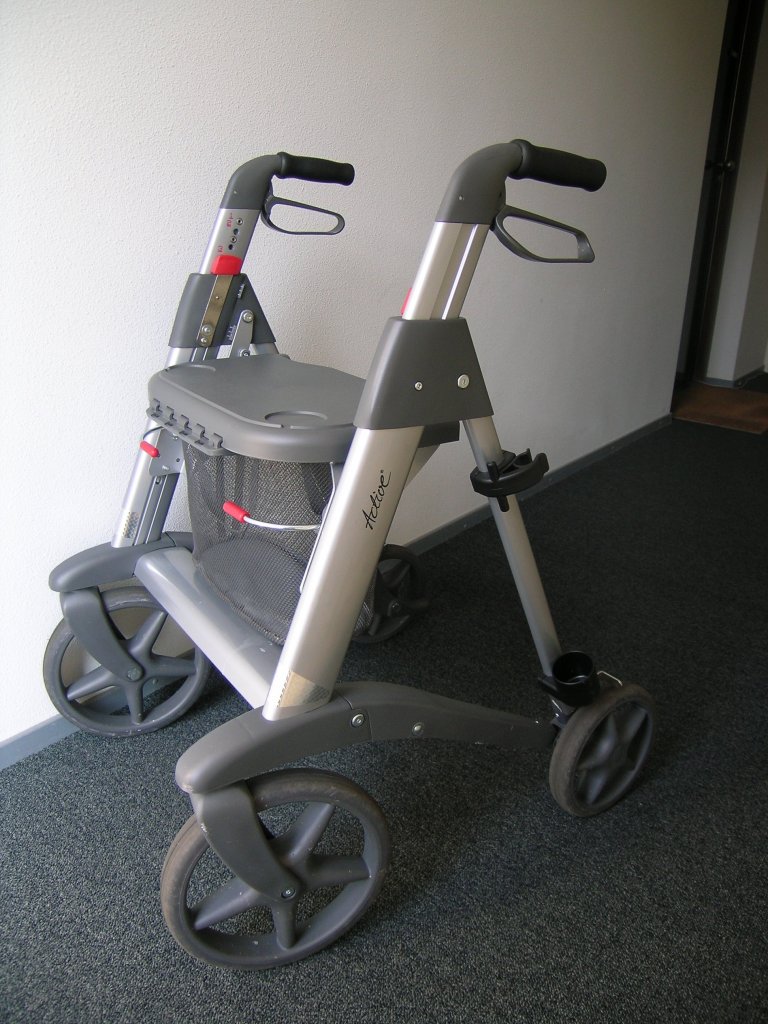
Teaching point: These photographs show equipment construction, not a prescription. Match the device to patient stability, upper-limb function, permitted loading, cognition and terrain.
Understand ordered weight bearing
Device gait patterns: two-point is reciprocal, pairing an assistive device and the opposite lower extremity; three-point is often used when one leg needs reduced or absent loading; four-point is a more deliberate sequence with more points of contact; swing-to and swing-through patterns appear in the source for selected crutch users. The right pattern requires more than matching a label to an orthopedic diagnosis.
Fitting/guarding reminders from lab: ensure the equipment is sound and adjusted to the person; check handgrip and upper-limb position; avoid inappropriate axillary pressure from crutches; monitor fatigue, quality of foot clearance and ability to turn. Reassess when the device creates unsafe compensation or excessive effort. Progressing to a less restrictive device is appropriate only when balance, strength and function support it.
Check stairs and community demands
Stair notes: use the available handrail and device according to ability and precautions. The course contrasts step-to with reciprocal stairs and uses the reminder “up with the stronger, down with the weaker” as an introductory pattern—not a universal rule. Device placement, guarding and sequencing depend on rail position, anatomy, loading instructions, and the ability to follow directions.
Community mobility adds distances, traffic and timing, inclines, rough or slippery surfaces, doorways, carrying items, distractions, fatigue and environmental barriers. The third gait lecture particularly emphasizes exploring WHY a fall happened, not just recording HOW, because multiple personal and environmental factors may contribute.
Check your reasoning: Can a person be taught a generic weight-bearing amount without their current order?
No. Exact loading instructions and device use follow patient-specific orders and clinical supervision.
Updated-standard context
Generic device fitting, stair rules and post-arthroplasty turning restrictions from older slides should be checked against the actual surgery, permitted loading and current rehabilitation instructions. The patient, task and environment determine the safe setup. Compare lab examples with your clinical-site training.
Apply it to a clinical situation
Scenario: A patient has an upper-limb weight-bearing restriction after surgery and a lower-limb loading restriction. A standard walker is available at bedside.
What changes your decision?
Reasoning: Do not select the walker on lower-limb status alone. Check permitted upper- and lower-extremity loading, balance, cognition, equipment options and assistance with the treating team.
Common mistake: Assuming a device is appropriate because it is commonly used for the leg restriction. Remember: Every device changes demands on the hands, shoulders, balance and environment.
Based on my FCS lecture/lab companion notes, Chapter 11. This is a student lesson; test forms, publisher diagrams and original restricted handouts are not reproduced. Follow current clinical supervision and policy.


