
FROM MY PT SCHOOL NOTES · GENERAL MEDICAL / POST-SURGICAL · CHAPTER 4
What Should You Check Before Mobilizing a Patient With Lines and Drains?
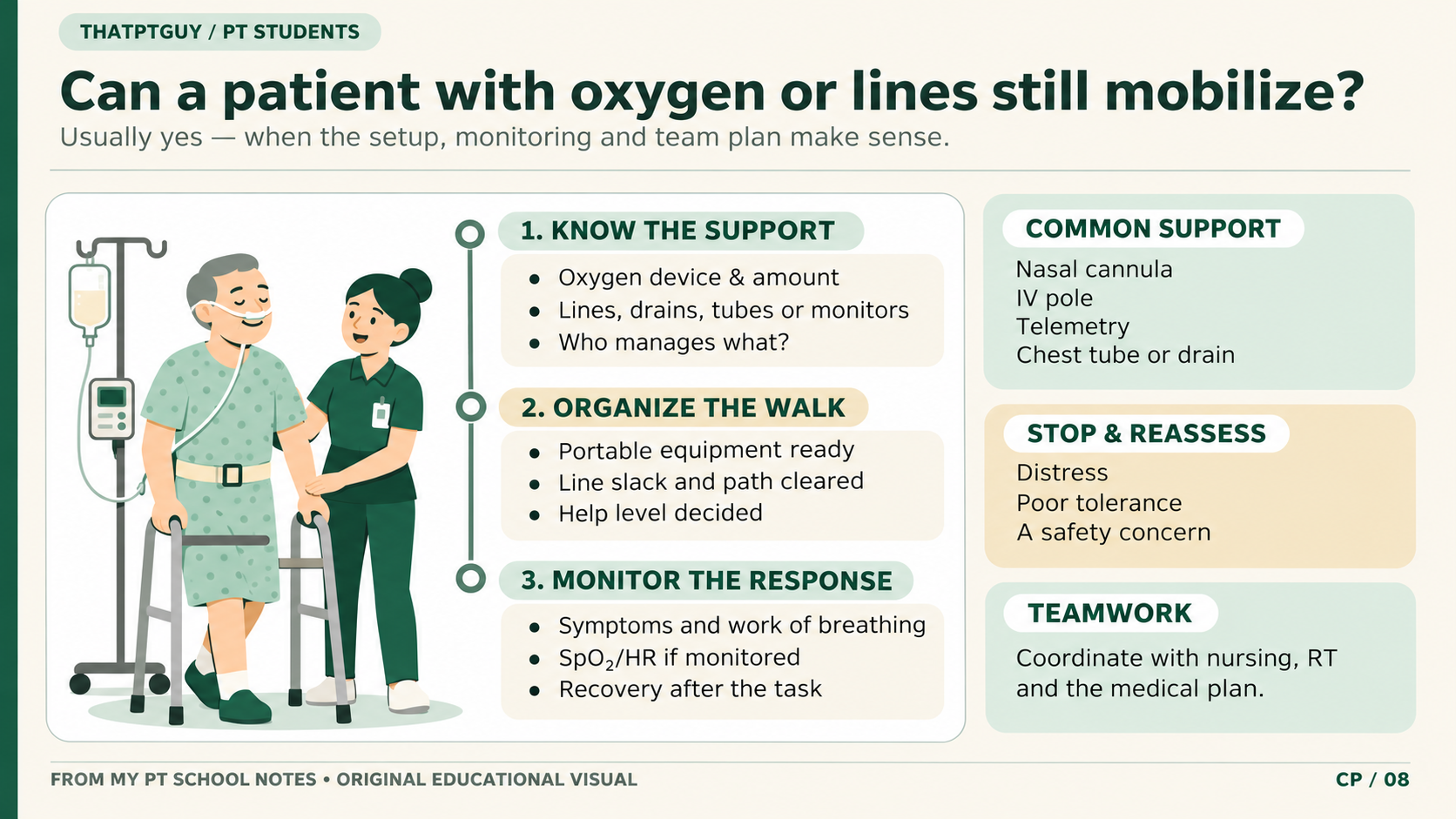
Oxygen, tubes, drains and lines change the setup, not necessarily the patient’s right to participate in safe mobility.
Know what the equipment does
The class covers peripheral IVs, central access, arterial monitoring, heart and respiratory monitors, supplemental oxygen, chest drainage, feeding tubes, bladder catheters, ventilation and circulatory support. Understand each device’s purpose before the transfer begins.
Plan the path before moving
Identify attachment/entry sites, securement, tubing length, alarms, drainage positioning and who is responsible for equipment management. Plan where the patient, therapist, furniture and device will be during mobility. Never improvise disconnecting or clamping unfamiliar equipment.
Protect devices and communicate
Lines, ventilators and oxygen are not automatic barriers to all movement, but their presence does not guarantee that movement is appropriate either. The patient’s medical stability, device type and team resources drive the plan.
Equipment terms to recognize from class: MAP is mean arterial pressure; PAC is pulmonary artery catheter; CVP refers to central venous pressure; PaO₂ is oxygen partial pressure on arterial blood gas, and SpO₂ is peripheral oxygen saturation by oximeter. Chest tubes, arterial-line transducers and invasive cardiovascular devices have equipment-specific setup and positioning requirements. An alarm, waveform change or accidental line displacement warrants immediate assessment by the responsible team—never attempt unauthorized reconnection.
Reasoning check: A chest drainage system is attached. Is it safe to disconnect it casually to make walking easier?
No. Follow the medical orders, device instructions and qualified team support rather than disconnecting or clamping without authorization.
Make the clinical connection
Scenario: A patient with a chest drainage system and supplemental oxygen is ready to attempt a chair transfer. The tubing crosses the planned route.
What is the next reasoning step?
Reasoning: Do not clamp, disconnect or reposition prescribed equipment casually. Coordinate equipment management with trained staff, clear the path and follow the specific orders before attempting the transfer.
Common mistake: Making the device an afterthought once the patient starts moving. Remember: Plan equipment, staffing and destination before movement.
Source basis: my General Medical/Post-Surgical school-notes companion, general medical section 4. These are educational principles, not clearance thresholds, orders or standalone medical management instructions. Follow current clinical protocols and competent team guidance.

