
FROM MY PT SCHOOL NOTES · FUNCTIONAL ANATOMY & BIOMECHANICS · REGIONAL CHAPTER 8
What Happens at the Shoulder When You Reach Overhead?
Overhead reach is not just a humerus moving in a socket. The scapula, clavicle and glenohumeral joint contribute together.
Name the pieces of the shoulder complex
The shoulder source reviews the glenohumeral, sternoclavicular, acromioclavicular and scapulothoracic relationships. The glenohumeral joint offers large mobility, while the scapula and clavicle position the glenoid relative to the moving arm.
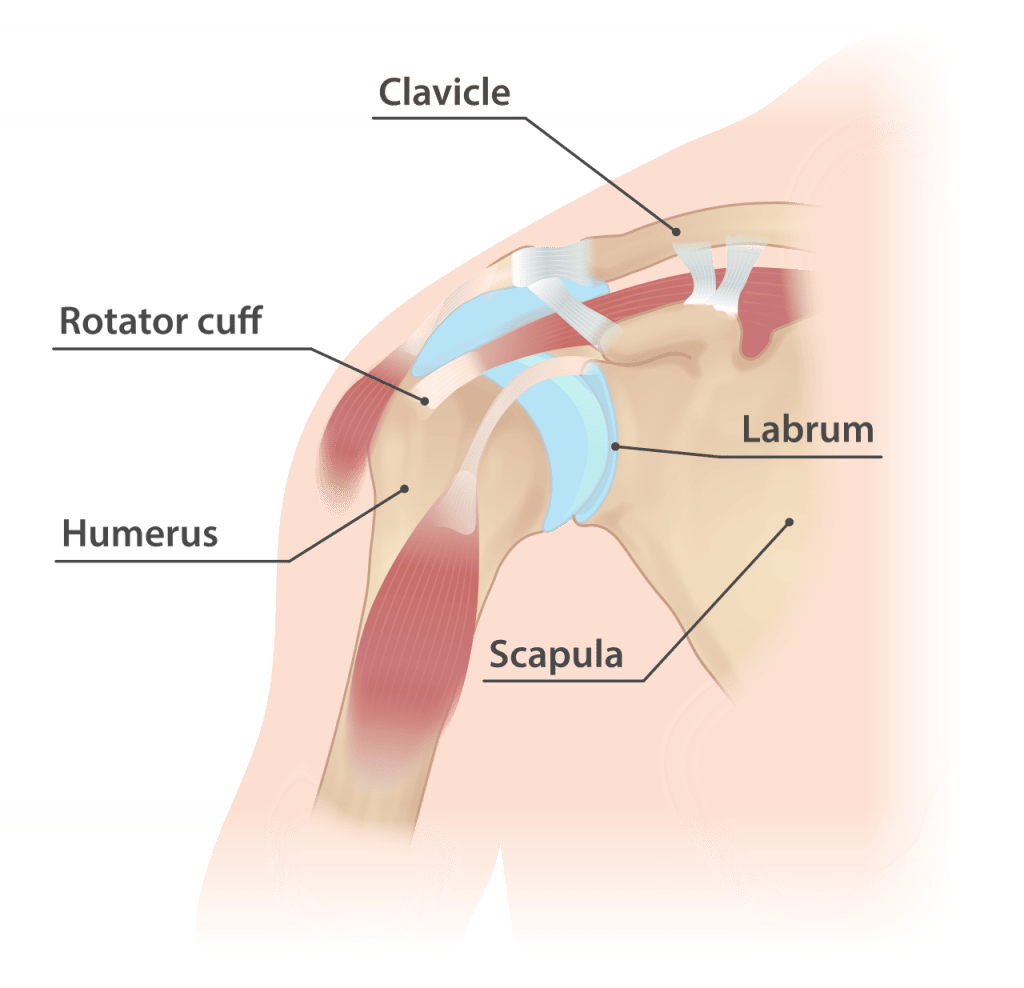
Useful landmarks from your lecture include the scapular spine, acromion, coracoid, glenoid, humeral head and greater/lesser tubercles. Learning where they are helps explain muscle attachments and the route of movement.
Visual reference: shoulder anatomy
Understand linked scapular and humeral motion
As the arm elevates, the scapula commonly upwardly rotates and changes tilt and rotation while the clavicle moves at its articulations. The lecture introduces scapulohumeral rhythm; treat any fixed numerical ratio as an introductory model, not a universal requirement.
The rotator cuff, deltoid and scapular muscles contribute force and stabilization through a changing range. Glenohumeral motion can involve roll, slide and spin that cannot be inferred from arm elevation alone.
Use reaching as your clinical example
Compare reaching to a shelf at shoulder height versus overhead with a load. The task changes movement range, trunk contribution and force demand. Ask what changed before deciding the cause of symptoms.
Observe scapular and humeral contribution, available range and task tolerance. Do not equate one movement variation with a diagnosis or use a simplified ‘impingement’ story to explain every painful shoulder.
Quick check: A patient achieves overhead reach with trunk extension. Does that prove the glenohumeral joint alone has full elevation?
No. Overhead reach can use combined scapular, glenohumeral and trunk contributions. Examine the relevant components rather than inferring one joint’s motion from the total task.
Try the mechanics on a real task
Example: A person can reach a shelf only when extending the trunk and changing scapular orientation; isolated arm motion appears more limited.
Work through the reasoning
Answer: The total reach is a combination of glenohumeral, scapulothoracic, clavicular and trunk movements. Observe the contributions and symptoms before inferring one specific tissue is deficient.
Common trap: Treating a successful overhead reach as proof of normal range at every joint. Remember: Total task motion and regional motion are not the same measure.
Course basis: Shoulder.pdf from my original FABIO folder. This is paraphrased teaching content, not a complete regional anatomy reference or diagnosis algorithm. Third-party textbook diagrams are intentionally omitted.


