
FROM MY PT SCHOOL NOTES · CARDIOPULMONARY · CHAPTER 7
When Is Airway Clearance Actually Indicated?
A treatment makes sense only if it addresses the patient’s current problem. The presence of a pulmonary diagnosis does not automatically mean percussion or postural drainage is needed.
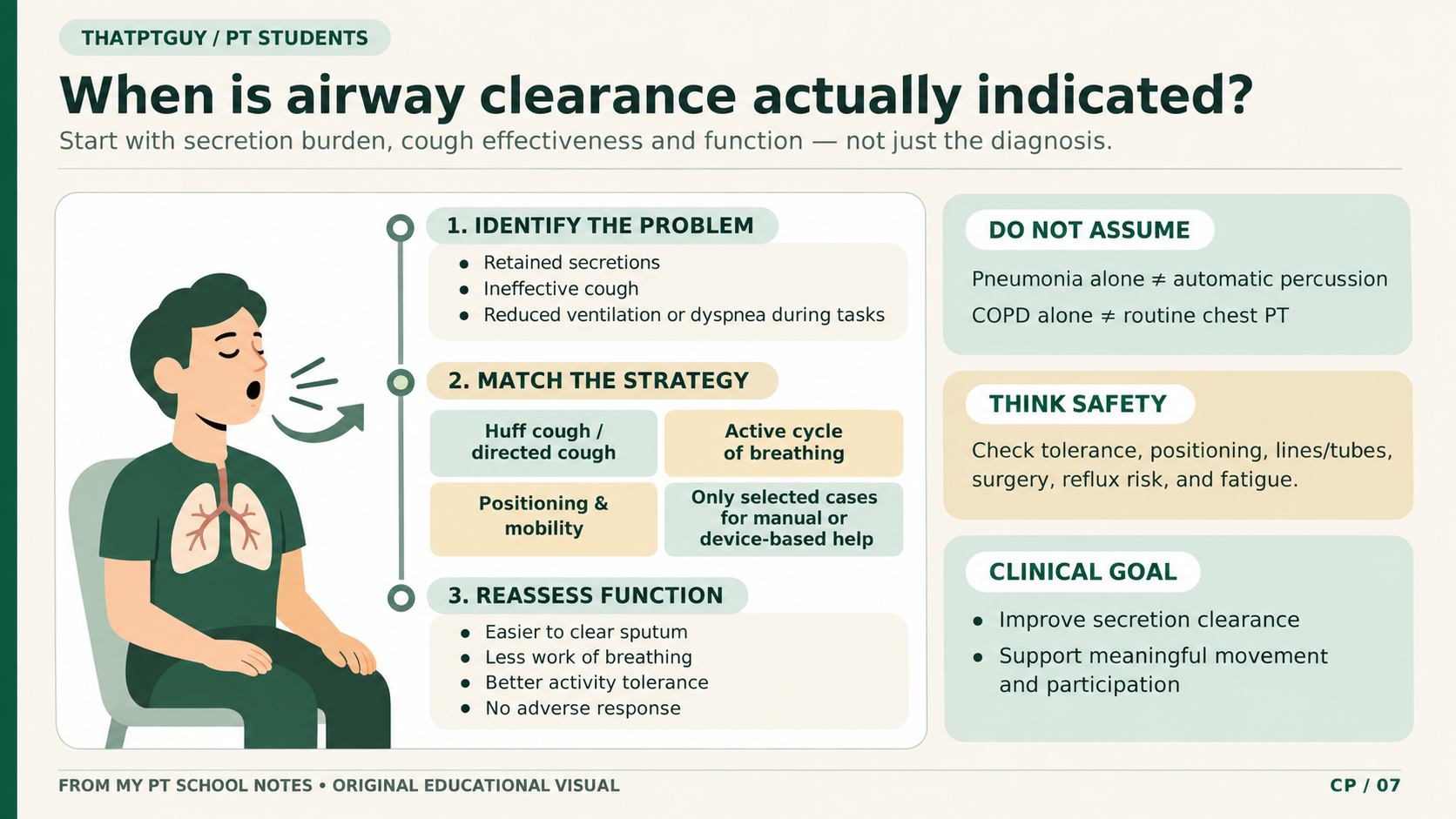
1. Start with a secretion problem, not a treatment technique
Airway clearance can be useful for selected people with secretions they cannot clear effectively. Before choosing a technique, consider cough strength, mucus burden, patient stability, the underlying condition and what would change if clearance improved.
The AARC guideline does not recommend routine chest physiotherapy for uncomplicated pneumonia or routine airway clearance for every patient with COPD. Symptomatic secretion retention is a different question and may justify individual assessment.
A patient with uncomplicated pneumonia has a productive, effective cough. Is routine percussion automatically indicated?
Reasoning: No. The diagnosis alone does not establish a need. Assess whether secretion clearance is actually impaired and consider the care team’s plan.
2. Know what different strategies are trying to accomplish
Huffing, directed cough and the active cycle of breathing are patient-participation approaches. Positioning, manual techniques and mechanical cough assistance have more specific indications and precautions. They are not interchangeable.
Postural drainage positions may be unsuitable with certain medical or surgical conditions. Artificial-airway suctioning requires appropriate expertise, scope and institutional protocols; the 2022 AARC guidance recommends indication-based practice and generally avoiding routine saline instillation.
Can an older classroom postural-drainage picture be applied to every current patient?
Reasoning: No. The position needs individual safety assessment, and published lecture images cannot simply be republished without rights.
3. Do not confuse dyspnea relief with secretion clearance
Pacing, supported positioning and selected breathing strategies may improve comfort during functional tasks, but they do not replace evaluation of new respiratory distress. The goal is better participation and appropriate symptoms, not completing a fixed number of exercises.
Reassess what changed: cough effectiveness, breathlessness during a task, activity tolerance or ability to mobilize secretions.
Should every breathless patient be taught the same breathing exercise?
Reasoning: No. Match the method to the person’s physiology, goals, tolerance and medical status.
Apply it to a clinical situation
Scenario: A patient with COPD says they have thick sputum that is difficult to bring up. Another patient with uncomplicated pneumonia can cough secretions out independently.
What is the stronger reasoning?
Reasoning: The secretion problem and cough effectiveness differ. Consider individualized airway-clearance assessment for the first person; do not automatically prescribe routine chest percussion to the second.
Common trap: Picking the technique first and searching for a reason afterward.
Sources & learning scope
Based on my Chapter 17 and airway-clearance lab notes, updated with AARC airway-clearance guidance and AARC artificial-airway suction guidance. No classroom images have been copied. This independent teaching summary is based on the author’s PT school notes; it is not a clinical protocol, certification or official exam guide.

