
FROM MY PT SCHOOL NOTES · CARDIOPULMONARY · CHAPTER 16
How can cardiopulmonary outcome measures show meaningful progress?
An outcome measure answers a particular question—walking capacity, symptoms, strength, participation or health-related quality of life. This chapter adapts the original outcome-measures lecture without treating a single test or one arbitrary threshold as proof of success.
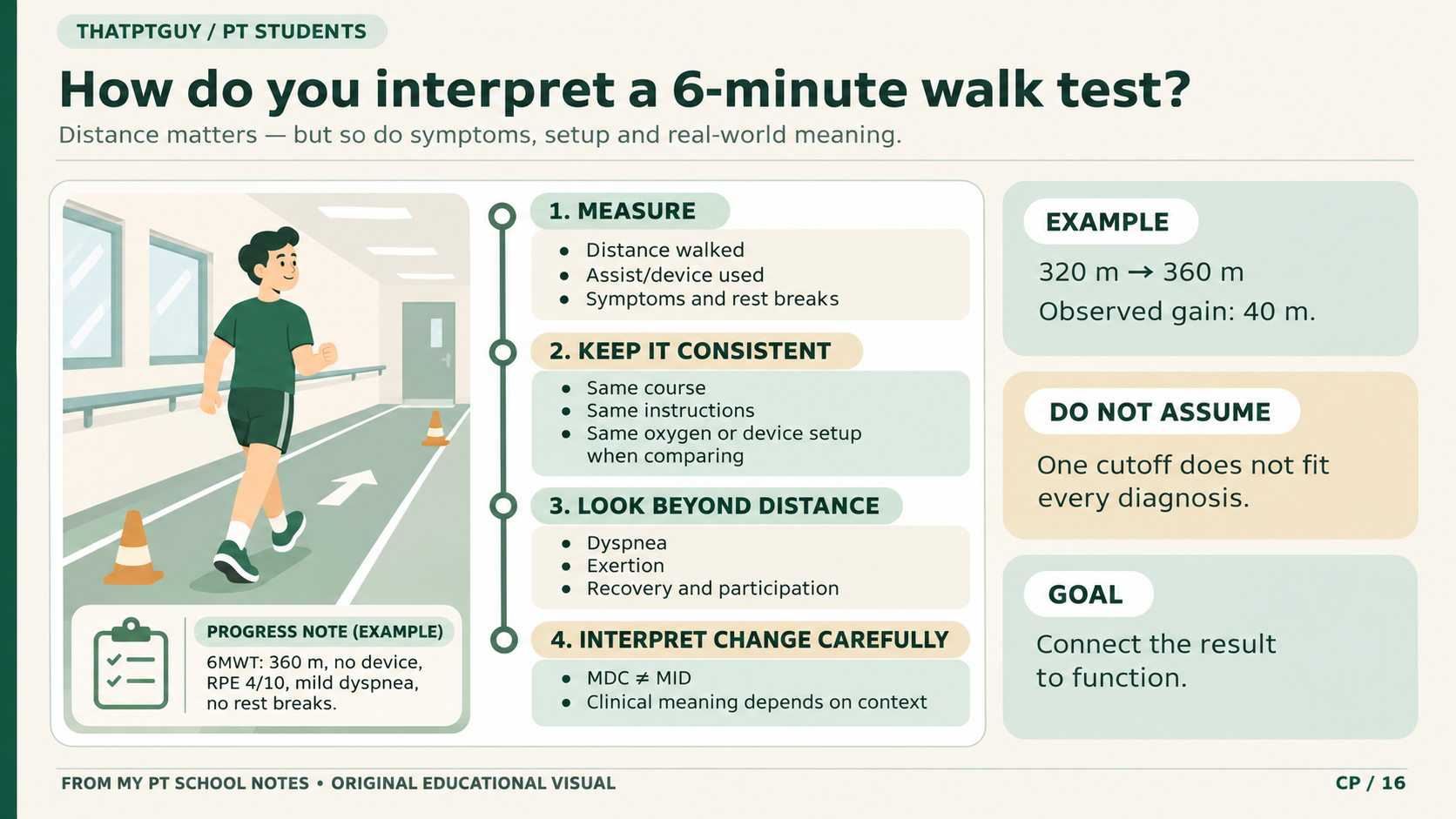
Choose a measure that matches the goal and patient
The six-minute walk test (6MWT) estimates functional walking capacity over six minutes using a standardized protocol. Distance is the primary outcome, but symptoms, oxygenation when appropriately monitored, assistance, oxygen-device settings and recovery also inform interpretation. A short walk test, gait speed or sit-to-stand test may answer a different functional question.
Cardiopulmonary exercise testing (CPET) may provide a more detailed exercise-capacity and physiologic assessment; peak oxygen uptake is not interchangeable with a self-paced six-minute walk distance. Patient-reported dyspnea and quality-of-life instruments assess symptoms or experiences rather than only distance. Choose the tool that connects to the planned rehabilitation decision.
Does a six-minute walk distance directly measure VO2peak?
Reasoning: No. It estimates functional walking performance and is not interchangeable with cardiopulmonary exercise testing.
Keep protocols constant when comparing visits
The ATS/ERS technical standard emphasizes consistent instructions and encouragement, walking course, oxygen or medication conditions, mobility devices, and measurement approach. If the 6MWT course or assistance changes, a different distance may reflect a measurement change rather than a physiological improvement. Source: https://publications.ersnet.org/highwire_display/entity_view/node/514756/full
The ATS field-walking resource updated in November 2024 lists different population-specific minimal important difference (MID) estimates: commonly around 25–33 m in COPD, with other ranges across respiratory diseases. The older course lecture’s single 86-m figure must not be generalized as a universal MCID. https://site.thoracic.org/assemblies/pr/outcome-measures/field-walking-tests
Can two walking distances be compared fairly if course length and oxygen support change?
Reasoning: Not directly. Protocol consistency and measurement context are important.
Distinguish measurement error from meaningful change
Reliability describes consistency; validity describes whether a measure represents the intended construct; responsiveness is the ability to detect change. Minimal detectable change (MDC) is a statistical estimate of change beyond expected measurement error under specified conditions. Minimal important difference (MID/MCID) refers to a magnitude that is meaningful, typically estimated for a particular population and method. These are not the same concept.
A published group-level MID should not be applied mechanically to tell one individual that their change is or is not meaningful. Consider measurement precision, baseline function, patient goals, symptoms and whether participation improves. Repeat tests consistently and document limitations.
Is a minimal detectable change identical to a minimal important difference?
Reasoning: No. MDC concerns expected measurement error; MID concerns meaningful magnitude in a defined context.
Apply it to a clinical situation
A patient’s 6MWT improves from 320 m to 360 m. Is this enough information to promise a meaningful return to community activity?
What matters in this decision?
Reasoning: No. Check protocol comparability, symptoms, the population-level meaning of the change and the patient’s real participation goals and experiences.
Common mistake: Relying on one diagnosis or isolated test rather than integrating the current clinical picture and the patient’s goals.
Source notes & learning scope
SOURCE NOTES: Chapter 22.pdf; Functional Evaluation cardio .pdf; Chapter 19 .pdf; Cardiopulmonary Lab 4 .pdf; Lab 6.pdf. Current reference: ATS 2024 field-walking resources, ERS/ATS technical standard. Older fixed thresholds and unqualified ‘gold standard’ claims should not be carried forward. This is an original educational PT school notes companion—not an official class document, clinical protocol or NPTE guarantee.

