
FROM MY PT SCHOOL NOTES · MOTOR CONTROL · CHAPTER 13
How do reaching, grasping and manipulation work together?
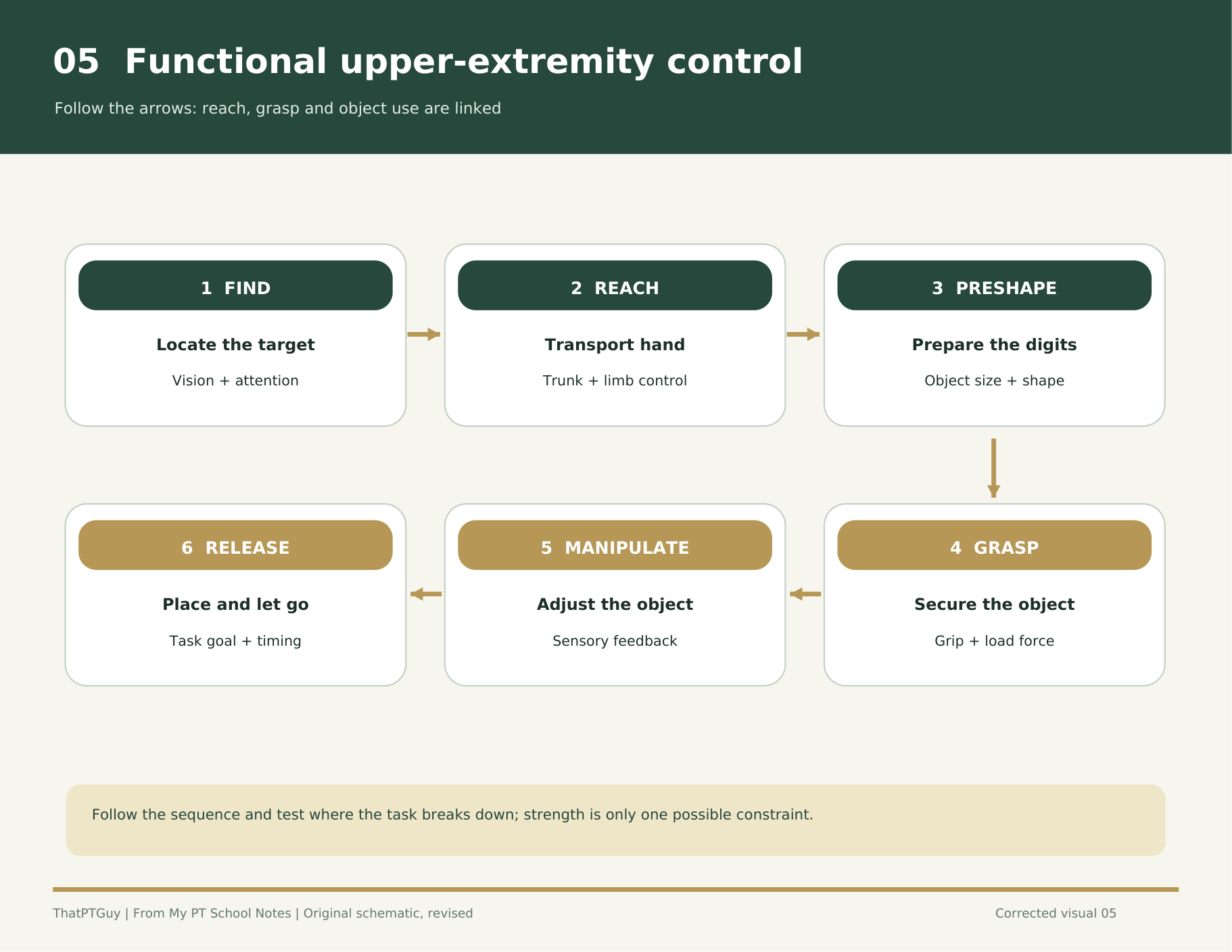
The big idea
Skilled upper-extremity function requires selecting a target, orienting vision and head, stabilizing trunk and shoulder, transporting the hand, shaping the digits, controlling grip and load, manipulating the object, and releasing it at the right place. Problems at any step can make the whole activity fail.
Feedforward And Feedback
A person often preshapes the hand before contact based on perceived object size and prior experience. After contact, tactile and proprioceptive signals guide adjustments in grip force as friction, weight or orientation changes. Vision is especially helpful for target localization and movement planning. When accuracy demands rise, movement may slow as additional control is required.
Grasp Types
Power grasps secure larger objects using broader hand contact; precision grasps support delicate object control; in-hand manipulation rotates, translates or shifts an item without placing it down. Hand strength matters, but it is not equivalent to dexterity, sensation or skillful task use.
Clinical Connection
Instead of ‘practice reaching,’ choose a meaningful example: reach to a cabinet, select the correct pillbox, transport a cup without spilling, or turn a key. Vary target location and object properties while monitoring task success and safety.
Pause and apply it
How can someone have good grip strength but still struggle with a key?
Try identifying the task goal, the movement strategy, and what you would measure before choosing an intervention.
A common point of confusion
A normal shoulder range does not guarantee effective hand use. Visual-perceptual constraints, attention, sensation and movement planning can be the more limiting factors.
Source notes and learning scope
Based on my original class notes: Normal Reach, Grasp, Manipulation; Reach, Grasp and Manipulation Changes Across the Life Span. This independently reorganized learning chapter is not a textbook reproduction, individualized treatment instruction, or NPTE guarantee. Compare it with your own coursework and current evidence.

