
FROM MY PT SCHOOL NOTES · MUSCULOSKELETAL · CHAPTER 04
Cervical Examination: When Does Urgency Change?
Your cervical lab starts with history and medical screening, then examines motion, motor control, neurologic function and familiar symptoms. The key is knowing when this should no longer be a routine mechanical examination.
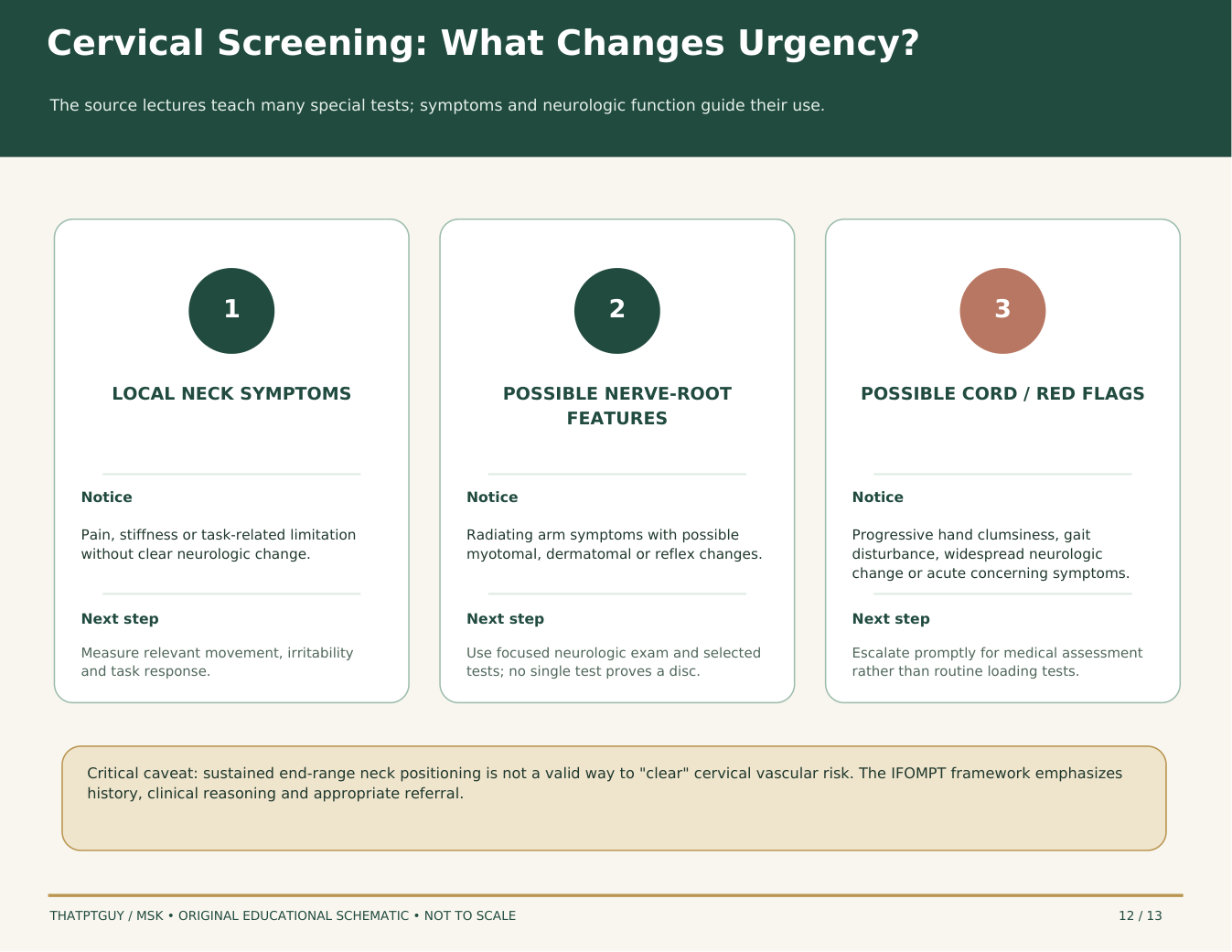
Think in cervical regions
The craniovertebral junction (C0–C2), lower cervical segments and cervicothoracic junction contribute differently to head and neck movement. Examine the patient’s actual task—turning to drive, sitting, reaching or sleeping—in addition to movement range.
The lab’s three observation lenses
Record quantity of motion, quality of movement, and familiar-symptom provocation. Assess relevant myotomes, sensation, reflexes, hand dexterity and gait when the story suggests nerve-root or spinal-cord involvement. A single positive movement test cannot specify a disc lesion.
When to change the pathway
Progressive hand clumsiness, abnormal gait or widespread neurologic change warrants timely medical assessment. Major trauma, acute severe unfamiliar neurologic symptoms or suspected vascular pathology need separate triage rather than neck loading.
A key lecture-era limitation
Historical lecture correction: the 2018 cervical special-test lab taught sustained extension/rotation vertebral artery positioning. IFOMPT’s 2020 framework does not recommend provocative positional tests for vascular clearance.
External guidance and verification (separate from original notes)
Try a clinical question
A person has neck stiffness but has also started dropping objects and walking unsteadily. What changes?
Do not assume simple mobility impairment. Clarify new or progressive neurologic findings, perform appropriate initial assessment and seek medical evaluation rather than continuing routine mechanical loading.
Original notes and scope
Cervical Spine; Cervical Spine Lab; Cervical Special Tests & Interventions.
My PT-school class notes, independently reorganized for learning. External evidence is identified separately. This is not an official course, validated diagnostic algorithm, individualized clinical protocol or NPTE guarantee.

