
FROM MY PT SCHOOL NOTES · CARDIOPULMONARY · CHAPTER 9
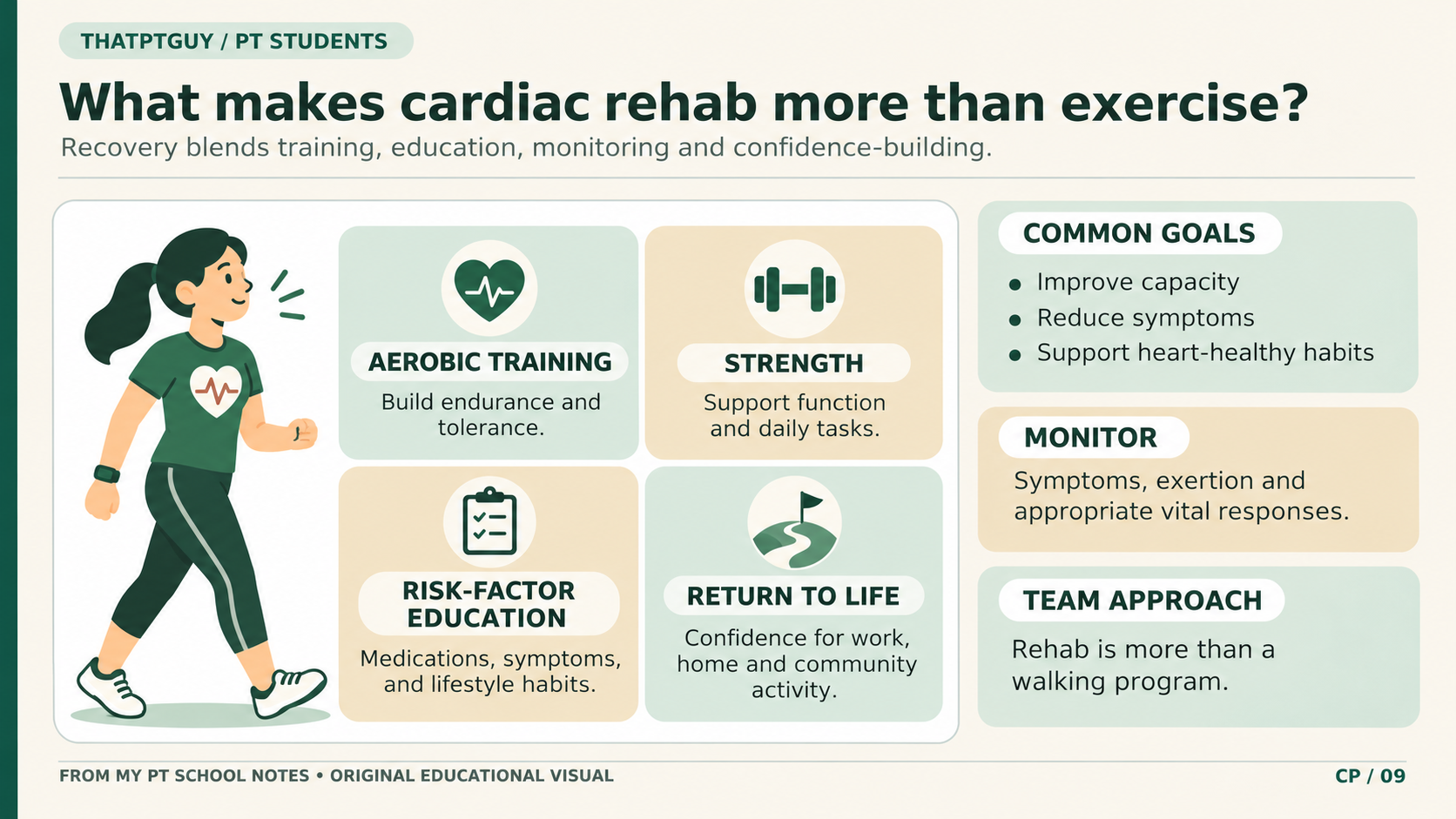
What Makes Cardiac Rehabilitation More Than an Exercise Program?
Cardiac rehabilitation addresses recovery and long-term risk, not just the number of minutes a person walks on a treadmill.
1. The program is multidisciplinary
Modern cardiac rehabilitation combines patient assessment, aerobic and strength exercise, risk-factor management, nutrition, psychosocial support, activity counseling and program quality. It is designed to support both function and prevention.
Depending on medical eligibility, patients may participate after selected cardiac events or procedures or with certain stable cardiovascular conditions. A PT may contribute mobility evaluation, exercise progression, balance assessment and behavior-focused activity planning.
Does a self-directed walking handout alone provide all the components of cardiac rehab?
Reasoning: No. A medically supervised cardiac rehabilitation program includes other core assessment, education, prevention and psychosocial services.
2. Progress the work the patient actually needs to do
Build toward daily activities such as climbing steps, shopping or gardening. Exercise progression reflects clinical evaluation, symptoms, relevant testing, medications, training response, comorbidities and the patient’s preferences.
Heart rate by itself can be misleading in some patients, such as those taking heart-rate-modifying medications. Use the appropriate multidisciplinary monitoring and prescription rather than a generic formula.
Can a single age-predicted heart-rate number prescribe the whole program?
Reasoning: No. Individual testing, medication, symptoms and clinical status shape training decisions.
3. Address barriers to continuing care
Fear after a cardiac event, access to transportation, program costs, competing responsibilities and low confidence can affect participation. High-quality rehabilitation addresses these barriers as well as physical capacity.
Home-based or virtual delivery can improve access when the essential clinical program and safety components remain in place.
A patient finishes supervised exercise but is afraid to leave the house. Is the rehab goal complete?
Reasoning: Not necessarily. Confidence, valued activity and sustained risk-factor and behavior support also matter.
Apply it to a clinical situation
Scenario: After coronary intervention, a medically stable patient wants to return to yard work but fears another heart event.
What is the stronger reasoning?
Reasoning: Clarify eligibility/referral for an appropriate supervised cardiac rehabilitation program. Translate the patient’s task into graded functional goals while the team addresses risk factors and confidence.
Common trap: Confusing a list of strengthening and walking exercises with the full rehabilitation program.
Sources & learning scope
Based on Chapter 18 and testing notes; updated using the AHA/AACVPR 2024 cardiac rehabilitation core-components statement. The yard-work case is original. This independent teaching summary is based on the author’s PT school notes; it is not a clinical protocol, certification or official exam guide.

