
FROM MY PT SCHOOL NOTES · FOUNDATIONS OF CLINICAL SKILLS · CHAPTER 5
How Do AROM, PROM, Goniometry and PNF Fit Together?
Describe exactly what movement was available and how it was tested before attaching meaning to a result.
Choose the type of movement
Range of motion terms in the FCS notes: passive ROM (PROM) is produced by an outside force; active-assisted ROM (AAROM) combines patient effort with assistance; active ROM (AROM) is produced by the patient. The lecture also asks students to recognize normal and limited movement, end feel, pain response, tone, rigidity and spasticity when choosing and examining a movement.
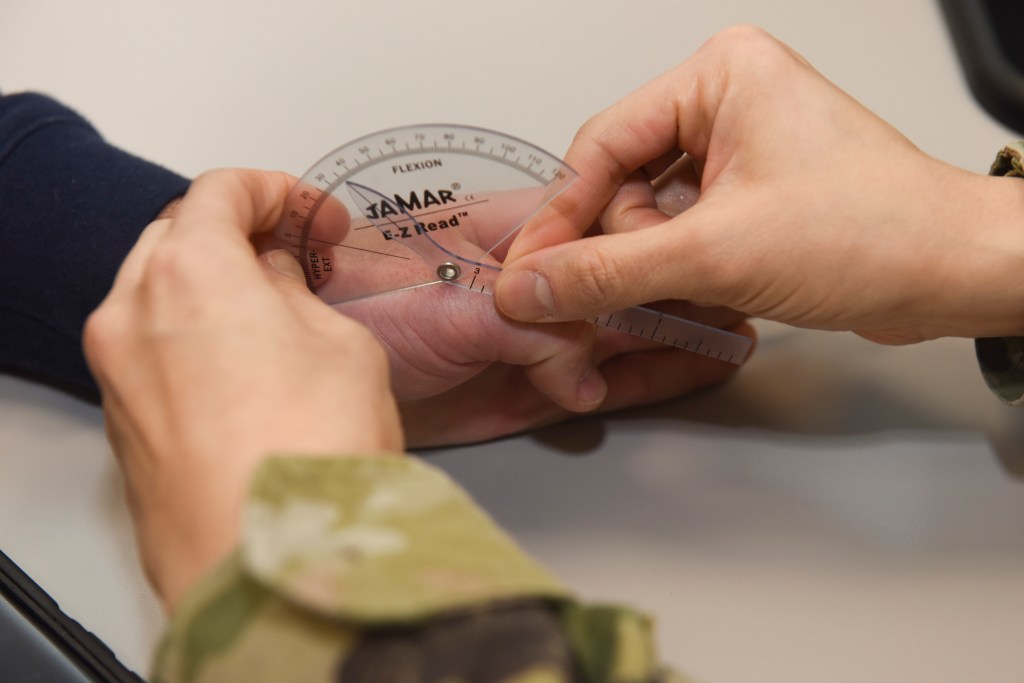
ROM examination reminders: identify the motion and side, test position, stabilization, direction and available range; compare AROM with PROM when relevant. Goniometry requires consistent joint landmarks, arm alignment and patient positioning. Record the actual measured angle and symptoms rather than just “WNL” when a number matters. Joint mobility and symptoms may be influenced by pain, soft tissue, capsular restriction, muscle length, neurologic tone or postoperative restrictions.
Clinical photo: measuring thumb ROM
Measure it consistently
The lecture covers PNF—proprioceptive neuromuscular facilitation—as combined spiral and diagonal movement patterns. Course concepts include proprioceptive input, facilitation, irradiation/reinforcement, successive induction and reciprocal inhibition. PNF is presented as a whole-person approach with emphasis on the movement the patient can perform, appropriate resistance, therapist contact, visual input, timing and verbal cues.
PNF procedure vocabulary from the class: manual resistance (direction and amount matter); irradiation (effort spreading to other muscle groups); traction or approximation (selected sensory/loading input); carefully chosen contact and body mechanics; and timing/emphasis within a pattern. Do not apply force merely because a pattern is in the notebook. The original lecture advises avoiding increased pain, approximation through an unhealed fracture and inappropriate forces at unstable joints.
Understand why PNF uses patterns
Diagonal patterns: D1 and D2 flexion/extension patterns are described for upper and lower extremities, with rotation as part of the movement. The course expects students to know the components and positions from lab demonstration. Compare diagrams and exact hand placements with your own practical notes rather than relying on this summary as a step-by-step treatment procedure.
Techniques: Rhythmic initiation progresses through assisted/passive familiarization toward more active movement; the course describes it for initiating motion, coordination and comfort with the pattern. Slow reversals alternate active contractions of opposing movement patterns without a prolonged pause; the notes connect them to control, coordinated transitions, strength and endurance. Match resistance and speed to the patient’s capacity.
Source notes: “PNF lecture.pdf” and “Terminology for PNF.pdf.” The original lecture mentions small historical research examples on flexibility and neurologic conditions; these are preserved as course context, not generalized proof of superiority.
Test your reasoning: Does PROM alone show a patient can actively control the same range?
No. PROM reflects available movement under an external force; AROM also depends on motor control and the ability to generate movement.
Apply it to a clinical situation
Scenario: A person reaches 120° of shoulder flexion actively and 155° when assisted. The active movement is slow and uncomfortable, while passive movement is tolerated.
What changes your decision?
Reasoning: That difference suggests available passive range exceeds the actively demonstrated range, but it does not diagnose the cause. Check measurement position, stabilization, symptoms, effort and relevant strength/motor findings before interpreting it.
Common mistake: Writing ‘shoulder ROM 155°’ without specifying whether it was active or passive. Remember: The method and context are part of a range-of-motion measurement.
Source: my Foundations of Clinical Skills companion notes, Chapter 5, summarized from the corresponding lecture and lab materials. Original student check; not a transfer credential, diagnosis or substitute for current facility procedures.


