
FROM MY PT SCHOOL NOTES · FUNCTIONAL ANATOMY & BIOMECHANICS · REGIONAL CHAPTER 12
Why Is Knee Mechanics More Than Flexion and Extension?
The knee is often drawn as a hinge, but its femoral, tibial and patellar structures must share and transfer force.
Know the main components
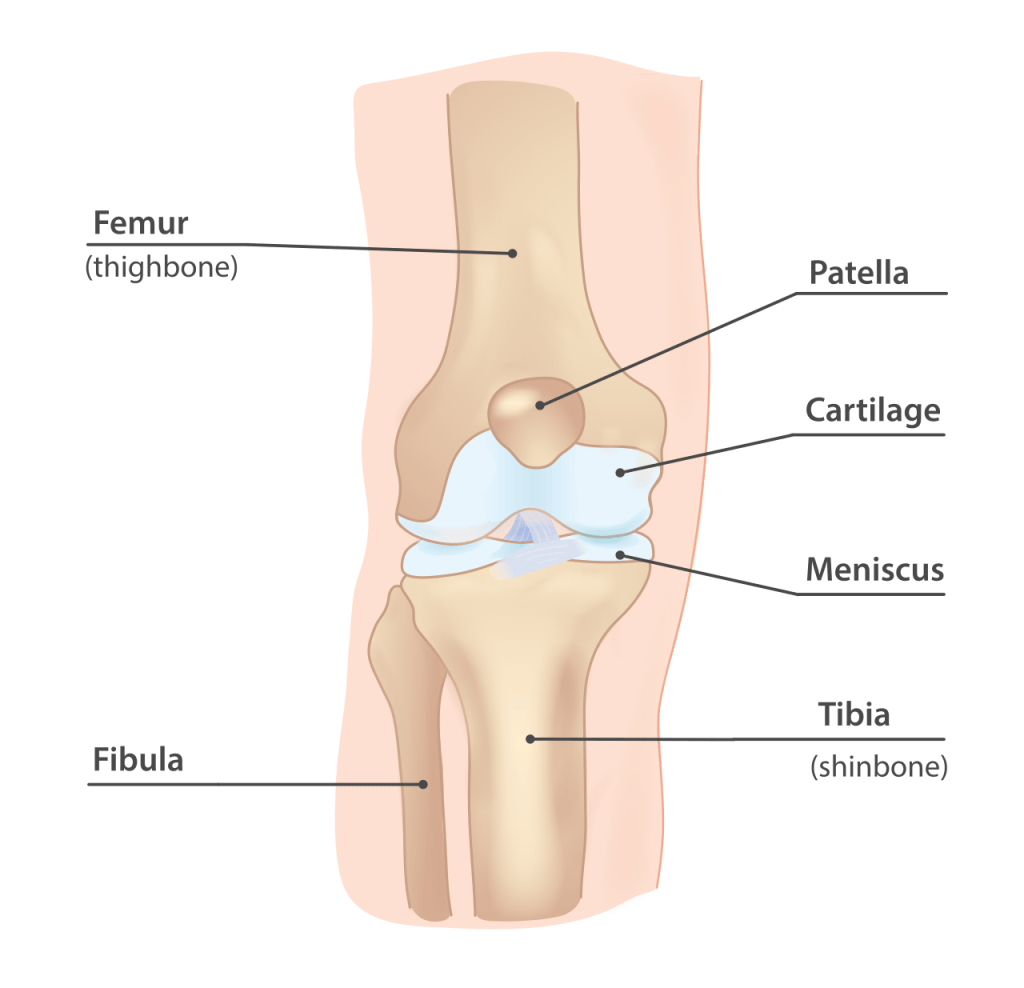
The course identifies the tibiofemoral and patellofemoral components and discusses the proximal tibiofibular articulation as part of the broader complex. Menisci, cruciate and collateral ligaments and capsular tissues contribute different roles.
The patella is embedded in the quadriceps tendon/extensor mechanism and influences how force is transmitted across the front of the knee.
Visual reference: major knee structures
Account for chain and rotation
The notes distinguish tibia-on-femur and femur-on-tibia motion. As the knee flexes or extends, arthrokinematic rolling, sliding and rotation can coexist. The source introduces the screw-home mechanism within defined motion and chain conditions.
A single picture showing a pure hinge can be useful for introductory naming but is not the entire kinematic story.
Apply it to tasks
Compare seated knee extension with a squat or sit-to-stand. Both use knee extension but differ in foot contact, segment movement, load path and hip/ankle contribution.
The course’s geometry explains different demands, not universal safety rankings. A patient-specific plan still requires assessment, current precautions and progression based on symptoms and goals.
Quick check: Does a seated open-chain knee extension have the same segment motion and loading context as a squat?
No. The distal segment and force environment differ, so the same broad joint-motion label doesn’t imply identical mechanics.
Try the mechanics on a real task
Example: A patient reports that seated knee extension is manageable but rising from a low chair is difficult.
Work through the reasoning
Answer: These tasks share knee extension but differ in support, load, moving segments and hip/ankle contributions. Analyze the chair height, foot placement, assistance and control rather than treating the two movements as identical.
Common trap: Assuming one isolated knee motion test predicts every functional movement. Remember: Closed-chain task context changes mechanical demand.
Course basis: Knee Lecture.pdf from my original FABIO folder. This is paraphrased teaching content, not a complete regional anatomy reference or diagnosis algorithm. Third-party textbook diagrams are intentionally omitted.


