FUNCTIONAL ANATOMY & BIOMECHANICS · CHAPTER 3 · ROTARY EQUILIBRIUM & JOINT FORCE
The weight is 20 N. Why might muscle force be 120 N?
A muscle can produce much more force than the object in the hand weighs. That doesn’t mean the anatomy is inefficient. It means force and moment arms must balance around the joint.
1. Separate the force from the turning effect
Your FABIO Principles lecture treats the limb as a lever system. Under static rotational equilibrium, the net moment about a chosen axis is zero. That doesn’t require the forces themselves to be equal.
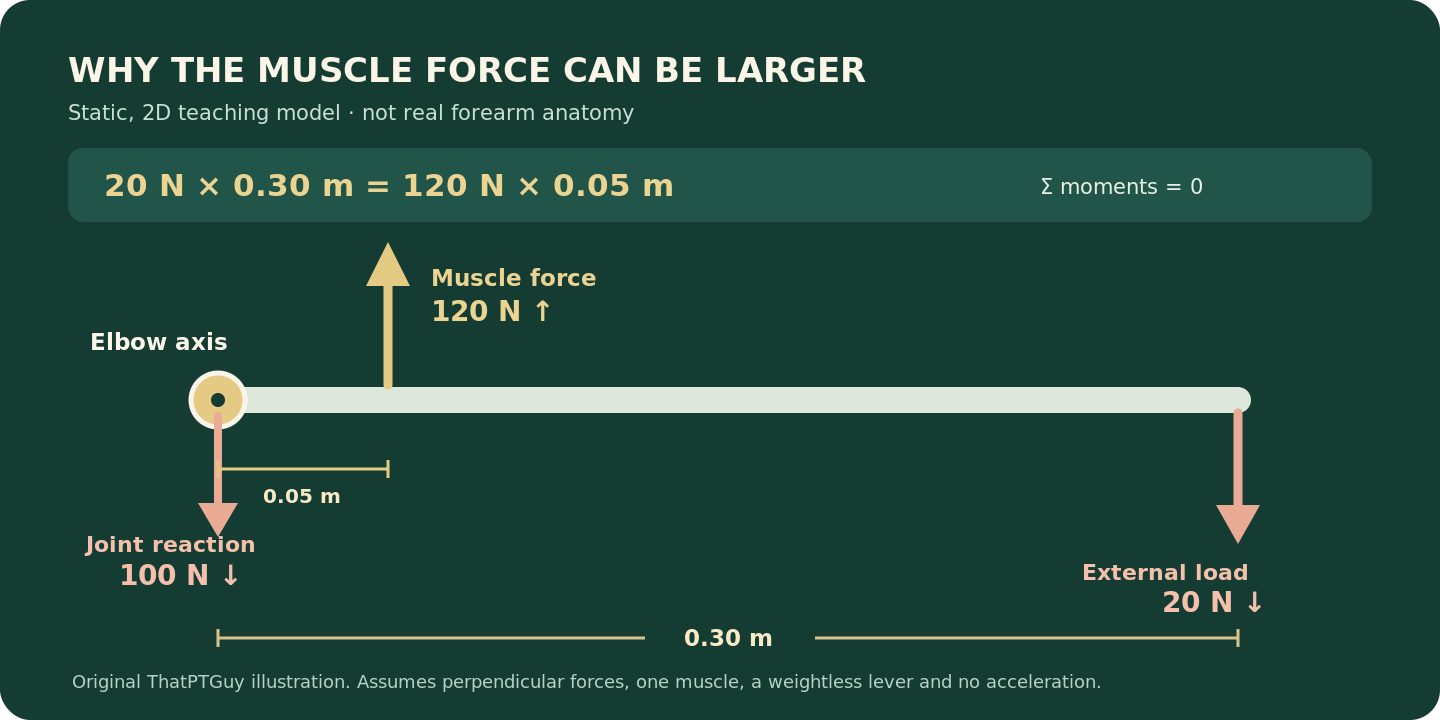
Use a simplified horizontal forearm model: an external downward force of 20 N acts 0.30 m from the elbow; one idealized upward muscle force acts 0.05 m from the elbow. Assume forces are perpendicular to the lever, the model is static, and segment weight and other contributors are omitted.
The external moment is 20 × 0.30 = 6 N·m. To balance it, the muscle force must create the same opposite moment: Fm × 0.05 = 6. That gives Fm = 120 N in this teaching model. Six times the external force—not because the object gained weight, but because the moment arm is six times shorter.
Quick check: If the external force stays at 20 N but moves from 0.30 m to 0.20 m, what happens to required muscle force in the same simplified model?
Reasoning: It drops from 120 N to 80 N: (20 × 0.20)/0.05 = 80. Keeping the model assumptions fixed is essential.
2. Why isn’t the whole limb accelerating upward?
Rotational balance is only part of the problem. The course also emphasizes static linear equilibrium: the sum of forces in each direction is zero.
With our one-dimensional assumptions, the muscle pulls up 120 N while the load pulls down 20 N. A 100 N downward joint reaction balances them, so the net vertical force is zero. The sign and direction change if you change the force geometry.
Notice the reasoning order: solve moments around the joint to infer the required effort force, then balance the linear forces to infer a joint reaction. Don’t subtract the hand load from the muscle force and call the result ‘joint compression’ in a real patient. Real joint loading is a vector problem.
Quick check: Why can the joint reaction have a nonzero magnitude when the net force on the segment is zero?
Reasoning: Individual forces can be large while their vector sum is zero. In the simplified example 120 N upward − 20 N downward − 100 N downward = 0.
3. The model is useful precisely because its assumptions are visible
A person’s forearm is not a weightless bar with one vertical muscle. Muscle force direction and moment arm change with joint angle, several muscles and passive tissues contribute, and segment weight and acceleration may matter.
That is why the correct conclusion is ‘a shorter internal moment arm can require a larger internal force’—not ‘every patient with elbow pain has 100 N of joint compression.’ The lecture’s joint reaction force section introduces the method, but the actual clinical loading cannot be calculated from this tiny example.
Use the explanation for reasoning about holding a grocery bag farther away or bringing a load closer to the body. Then assess the patient and task rather than inferring injury from a single modeled force.
Quick check: An actual patient has elbow pain carrying groceries. Does this equation alone prove the painful tissue?
Reasoning: No. It estimates mechanical effects under simplified assumptions; diagnosis and treatment decisions require a broader examination.
Sources & learning scope
Directly based on the original FABIO Principles.pdf sections on parallel force systems, rotary equilibrium, static linear equilibrium, third-class levers and joint reaction force. The 20 N, 0.05 m and 0.30 m example is an original educational model, not a copied exercise, anatomy illustration or patient-specific load estimate.
Next topic: how osteokinematics and arthrokinematics describe different aspects of joint motion.
Try the mechanics on a real task
Example: In the simplified static lever from the lecture, the external moment remains 6 N·m but the muscle moment arm is 0.04 m rather than 0.05 m.
Work through the reasoning
Answer: To balance the same moment, the idealized muscle force is 6/0.04 = 150 N rather than 120 N. This assumes one perpendicular effort force, no segment weight and no acceleration; real anatomy is more complex.
Common trap: Applying the classroom reaction-force number to an actual patient joint. Remember: The calculation explains leverage, not a person-specific tissue load.
From My PT School Notes · Educational examples, not an individualized clinical protocol or an official exam-preparation product.