
GENERAL MEDICINE & POST-SURGICAL · CHAPTER 1 · ACUTE-CARE MOBILITY READINESS
Is this patient ready to get out of bed?
The patient is awake, they want to walk, and the order says activity as tolerated. Is that enough to start? In acute care, a good session often begins before the patient moves.
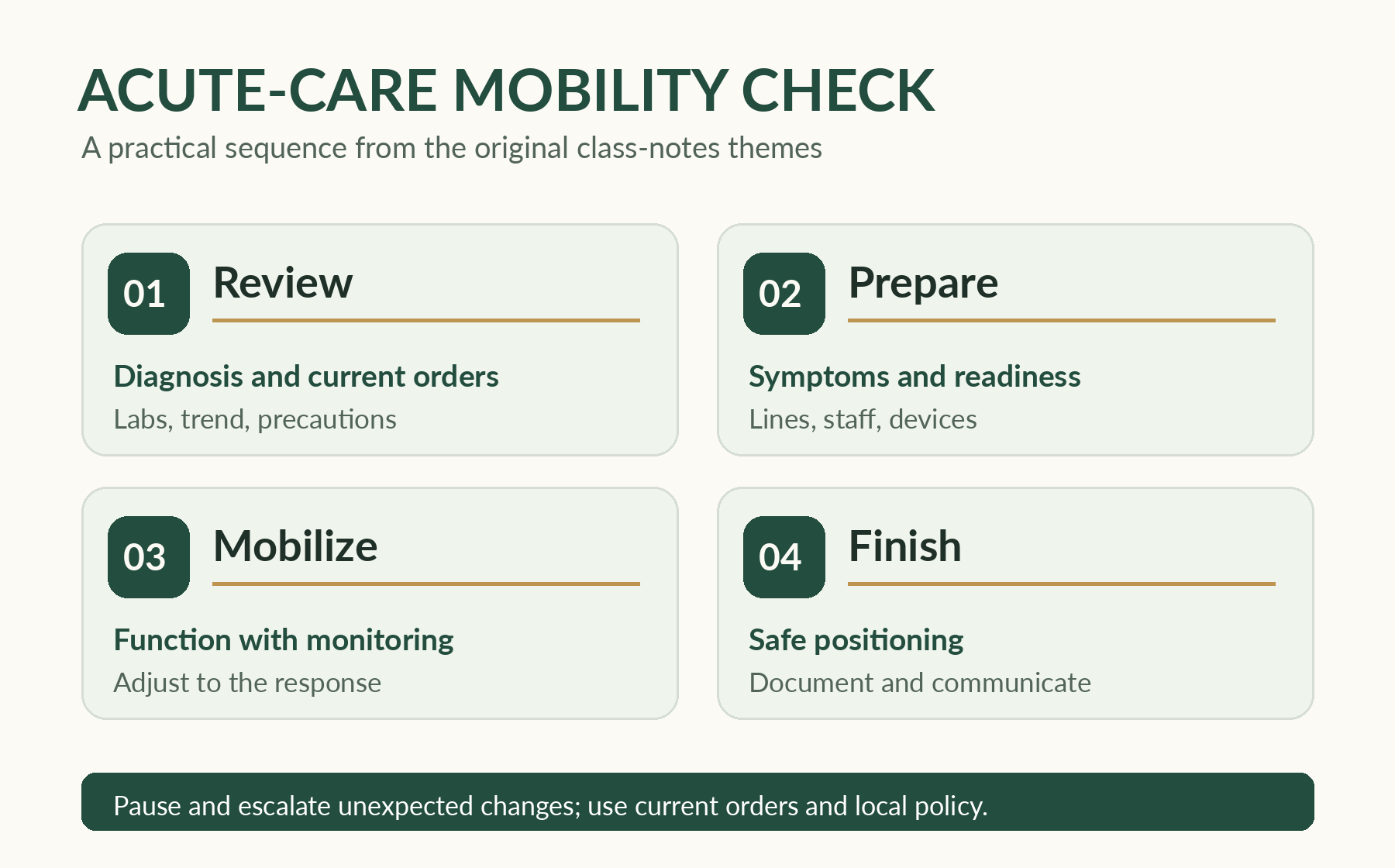
1. What changed before you arrived?
Your Gen Med/Post-Surgical notes emphasize reviewing the admission diagnosis and recent procedures, activity and weight-bearing orders, relevant medications, vital-sign trends, lab findings, lines or drains, cognition, infection precautions and anticipated discharge needs. Check for new events—not just yesterday’s note.
An isolated vital-sign value is not the whole story. The trend, the patient’s baseline, associated symptoms and the reason for hospitalization all change how a result should be interpreted. If restrictions or medical stability are unclear, clarify them with the responsible team rather than choosing your own cutoff.
Quick check: the latest blood pressure looks acceptable. Can you skip the rest of the review?
Reasoning: No. A single reading cannot replace review of orders, recent procedures, clinical trends, symptoms and the equipment that will accompany mobility.
2. What does the patient tell you now?
Confirm identity using the facility’s required identifiers. Explain your role, ask permission, check alertness and symptoms, and determine what the patient can contribute. Watch for new dizziness, chest discomfort, unusual breathlessness or a change from baseline.
Before moving, check who will manage the IV pole, oxygen setup, drains and other equipment. Arrange a clear pathway, appropriate footwear, assistance and destination. A transfer plan that forgets the lines is not a complete transfer plan.
A useful plan may be sitting upright, a bedside transfer, a short walk or positioning for comfort—not automatically a trip down the hallway. Align the activity with medical readiness and the person’s functional goal.
Why mobility matters
The original course reviews effects of immobility on muscle, endurance, upright tolerance, ventilation, joints, skin and function. Early movement can be useful when medical status and orders support it.
3. What should determine the next step?
During the task, monitor the patient and the response: symptoms, breathing, observed work of movement, assistance needs, relevant vital signs and recovery. A new concerning response changes the decision, even if the original plan was more ambitious.
Example: following abdominal surgery, a patient tolerates supported sitting but becomes newly lightheaded on standing. Do not push to complete the hallway walk for the sake of the plan. Assist the patient to a safe position, reassess and communicate with the clinical team as indicated.
After the session, leave the patient and environment safe: communicate, secure the bed/chair appropriately, position equipment, and make the call light accessible.
Quick check: the patient tolerates sitting but develops significant new dizziness when standing. Best next move?
Reasoning: Return to a safe supported position, assess the response, and communicate or escalate according to the care setting’s procedures. The original walking target does not override new symptoms.
Sources & learning scope
Based on the first section of the user’s General Medical, Post-Surgical & Wound Care companion and acute-care class notes. This is a student decision framework, not a universal medical clearance checklist. Follow patient-specific orders, supervision and local protocols; do not use a single vital-sign cutoff as automatic clearance. Next lesson: interpreting vital-sign trends and the patient’s response to movement.
Make the clinical connection
Scenario: A patient has a new activity order but also underwent a procedure after yesterday’s therapy session. The prior note says they walked independently.
What is the next reasoning step?
Reasoning: Review the current procedure, orders, clinical status, restrictions and equipment before relying on the old walking note. The ability yesterday is useful context but does not establish today’s readiness.
Common mistake: Letting the previous note substitute for current assessment. Remember: Each mobility decision begins with updated context.
From My PT School Notes · Companion learning content. Examples are for study, not individualized medical advice or a substitute for supervised lab instruction.

