
FROM MY PT SCHOOL NOTES · GENERAL MED / WOUND CARE · CHAPTER 17
How Do You Identify and Prevent Pressure Injury?
A pressure injury is more than a skin color change; it reflects tissue loading and vulnerability.
Compare two different skin-injury mechanisms
Pressure and shear
Think about local loading near a bony prominence or beneath a medical device. Consider positioning, mobility, sensation, perfusion and the loading history.
Moisture-associated damage
Think about prolonged contact with urine, stool, sweat or exudate and resulting inflammation or maceration. Distribution and exposure history help narrow the cause.
Important: These processes can coexist. Appearance alone does not establish etiology or permit pressure-injury staging; use a comprehensive clinical assessment and current classification guidance.
Understand pressure and shear
Pressure injuries result from pressure, often combined with shear, and are influenced by tissue tolerance. Bony prominences and medical devices are common risk sites. Reduced sensation, poor perfusion, limited mobility, critical illness and moisture problems increase vulnerability. Inspect skin under and near devices as well as the usual sacral and heel areas.
Recognize staging and differential concerns
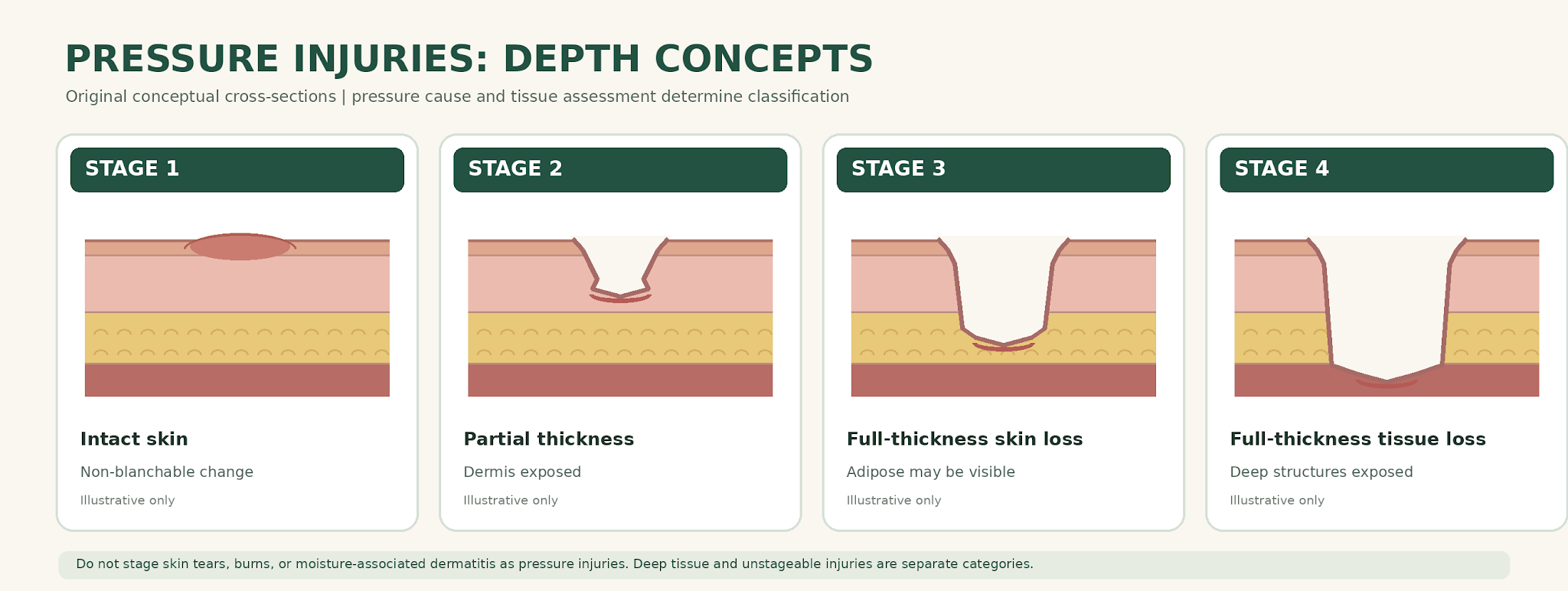
The schematic below compares basic tissue-depth concepts for pressure injuries. Tap the image to open a larger version. These are not clinical photographs or complete classification criteria.
Preventive and treatment themes in the notes: reduce sustained loading; reposition based on individual need; provide appropriate support surfaces; protect heels and other vulnerable sites; address equipment pressure, moisture and nutrition; and help the care team achieve safe transfers and mobility. Do not use donut-style rings for pressure relief.
Children are proportionally more vulnerable at the occiput and at medical-device contact points, while adult cases frequently involve the sacrum and heels. A support surface does not eliminate the need to reassess skin, adjust positioning or address moisture. Repositioning intervals should be individualized rather than assumed to be exactly every two hours for every patient. Documentation should record site, dimensions, tissue, margins, periwound, exudate, pain and the source of pressure so the treatment plan can be evaluated over time.
Modify loading and prevention plans
Staging reminder from the lecture: a Stage 2 pressure injury does not contain granulation tissue or slough because it is partial thickness. A full-thickness injury with adipose exposure is Stage 3 unless deeper structures are exposed or directly palpable, which raises Stage 4; when eschar/slough hides the wound’s actual depth, it is unstageable. Moisture-associated dermatitis, burns and skin tears should not be given a pressure-injury stage. Changes can look different in dark skin tones.
Caution: stable, dry, adherent eschar on an ischemic limb or heel is not automatically something to remove. Clinical context, vascular status and infection signs matter.
Check your reasoning: Is a skin tear automatically a Stage 2 pressure injury because the dermis is exposed?
No. Staging applies to pressure injuries; skin tears and moisture-associated damage have different etiologies.
Make the clinical connection
Scenario: A patient with limited sensation has nonblanchable discoloration over a bony prominence. Another has superficial moisture damage in a skin fold.
What is the next reasoning step?
Reasoning: These findings can have different causes. Pressure injury staging applies to pressure/shear-related tissue injury, not automatically to moisture-associated damage. Follow current classification guidance and examine the context.
Common mistake: Calling every partial-thickness skin change ‘Stage 2.’ Remember: Etiology comes before staging.
Current reference (separate from my class notes): 2026 International Pressure Injury Guideline. Use the current professional classification and guidance. The guideline’s detailed staging graphics are copyrighted and are not reproduced here.
Source: my General Medical / Wound Care class-note companion, wound section(s) 6. This is a conceptual educational lesson, not a wound assessment credential or a patient-specific treatment protocol. Dressing, staging and intervention decisions require appropriate training and current professional guidance.

