
FROM MY PT SCHOOL NOTES · MOTOR CONTROL · CHAPTER 01
What determines how we move?
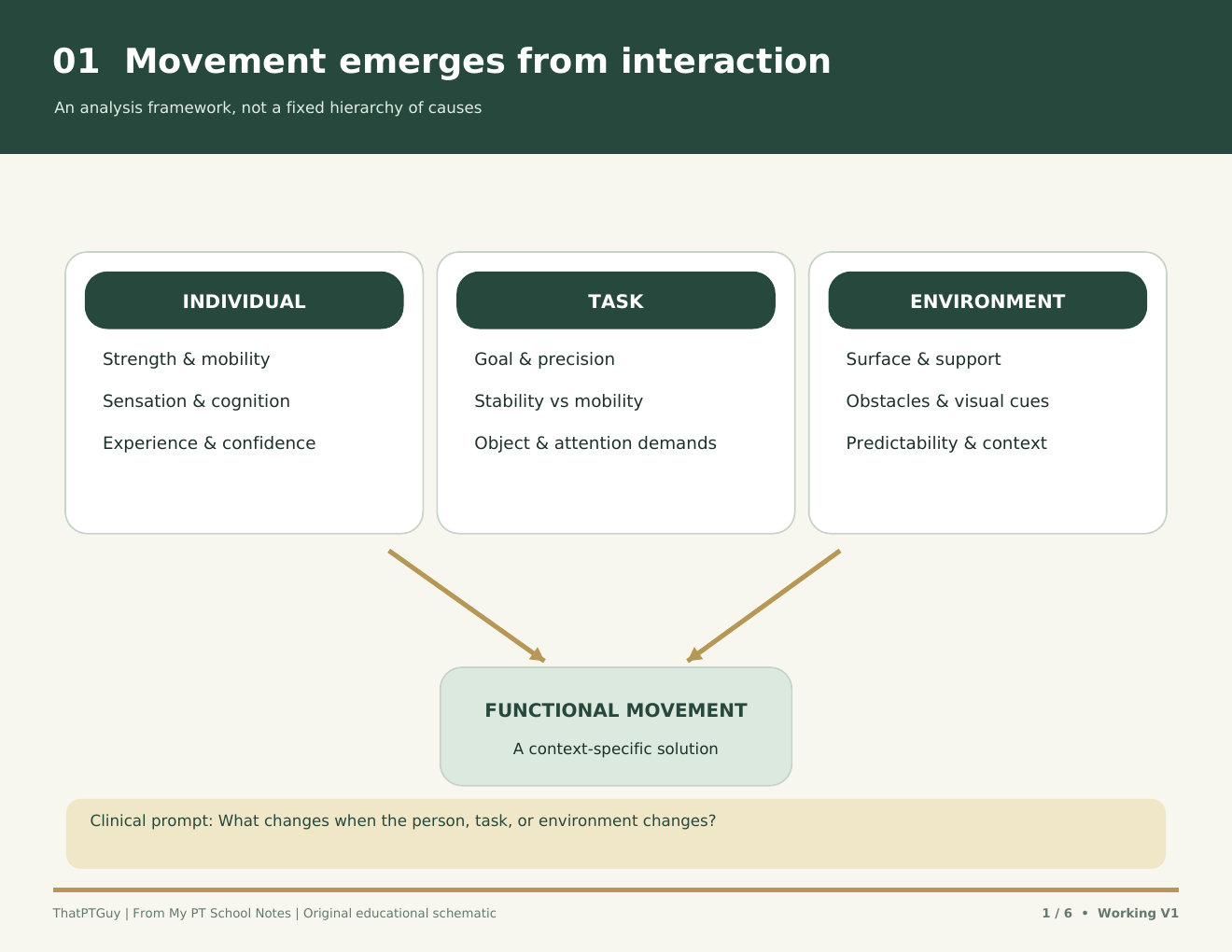
The big idea
Movement is not produced by the nervous system in isolation. It emerges as the person attempts a task in a particular environment. The person brings strength, mobility, sensory information, goals, attention, experience, and health; the task provides a goal and constraints; the environment supplies supports, obstacles, and useful cues.
A practical way to analyze a difficult movement is to change one of these three elements at a time. Someone may rise from a chair smoothly in a quiet clinic but struggle with a low, soft sofa while holding a child. A new diagnosis is not required to explain the difference: seat height, arm support, attention, surface compliance, fatigue, and perceived safety all modify the solution.
Important task dimensions include discrete versus continuous movement, stability versus mobility demands, whether objects must be manipulated, and predictable (closed) versus changing (open) conditions. Regulatory environmental information changes how movement must be organized—such as the height of a step. Nonregulatory information can affect comfort or attention without necessarily dictating the movement pattern.
Clinical Connection
Start with a meaningful activity. Observe the result, the strategy, and the constraints. Do not assume there is one universally ‘normal’ way to complete it.
Pause and apply it
A patient rises from a firm clinic chair but not from a low sofa. Which constraint would you test first?
Try identifying the task goal, the movement strategy, and what you would measure before choosing an intervention.
A common point of confusion
Task-specific does not mean identical repetitions forever. The ultimate goal is a movement solution that remains effective as real-world demands change.
Source notes and learning scope
Based on my original class notes: Motor Control Issues and Theories; Conceptual Framework for Clinical Practice. This independently reorganized learning chapter is not a textbook reproduction, individualized treatment instruction, or NPTE guarantee. Compare it with your own coursework and current evidence.

