
FROM MY PT SCHOOL NOTES · MOTOR CONTROL · CHAPTER 02
Which motor-control theories are useful in rehabilitation?
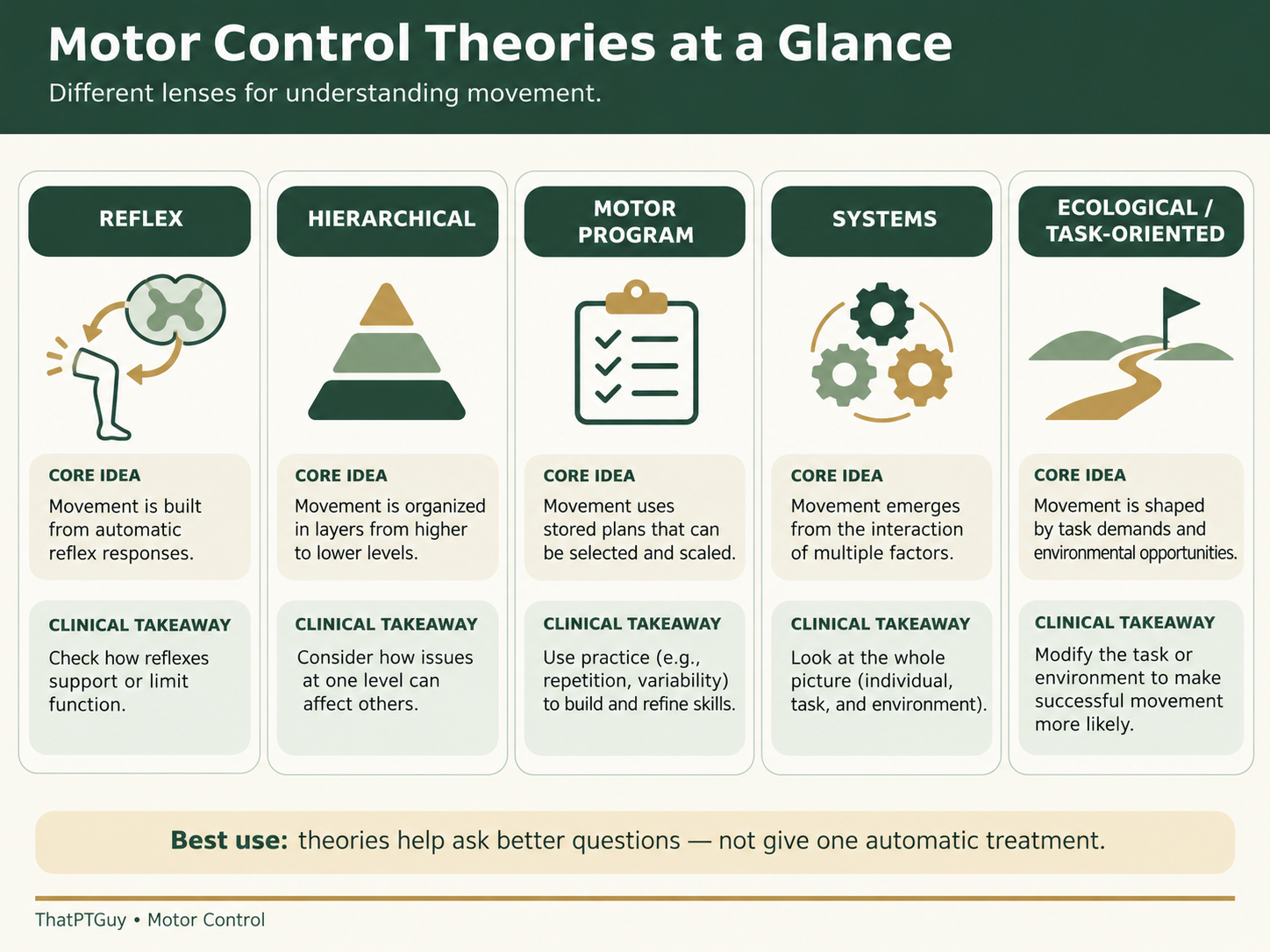
The big idea
Theories are models that help ask better questions, not complete explanations of every movement. Reflex and hierarchical theories historically emphasized reflex pathways and levels of nervous-system control. Motor-programming perspectives emphasize centrally organized movement patterns and the ability to produce some actions without continuous sensory correction. Systems perspectives highlight the interaction of multiple body segments, forces, and available degrees of freedom. Ecological/task-oriented perspectives stress perception, environmental information, and goal-directed action.
Why These Theories Matter
Reflex models help explain some protective and automatic responses but do not account fully for novel voluntary movements. Hierarchical accounts describe neural organization but cannot explain all context-dependent effects of lower neural networks. Motor-programming models help explain rapid or rhythmic actions but cannot eliminate the importance of feedback, body mechanics, and context. Systems and ecological perspectives encourage assessment of the interaction between the person, task, and environment; neither should be reduced to ‘the environment fixes everything.’
A therapist choosing to practice a meaningful transfer rather than only facilitating a preferred muscle pattern is making a different assumption about how motor skills improve. Task-oriented approaches do not reject impairment treatment; they connect it directly to function.
Clinical Connection
For reduced stair ability, consider quadriceps capacity, available ankle dorsiflexion, sensation, step geometry, confidence, and the patient’s chosen strategy. Test hypotheses instead of choosing a treatment from theory alone.
Pause and apply it
When does practicing the patient’s actual task answer a question that isolated pattern facilitation cannot?
Try identifying the task goal, the movement strategy, and what you would measure before choosing an intervention.
A common point of confusion
Historical neurofacilitation approaches (e.g., Bobath/NDT, Rood, Brunnstrom, PNF) are part of the course’s theoretical history. They should not be presented as automatically superior to goal-directed practice.
Source notes and learning scope
Based on my original class notes: Motor Control Issues and Theories; Conceptual Framework. This independently reorganized learning chapter is not a textbook reproduction, individualized treatment instruction, or NPTE guarantee. Compare it with your own coursework and current evidence.

