
FROM MY PT SCHOOL NOTES · MOTOR CONTROL · CHAPTER 04
How is motor learning different from performance?
In this chapterThe big ideaPractice OptionsClinical Connection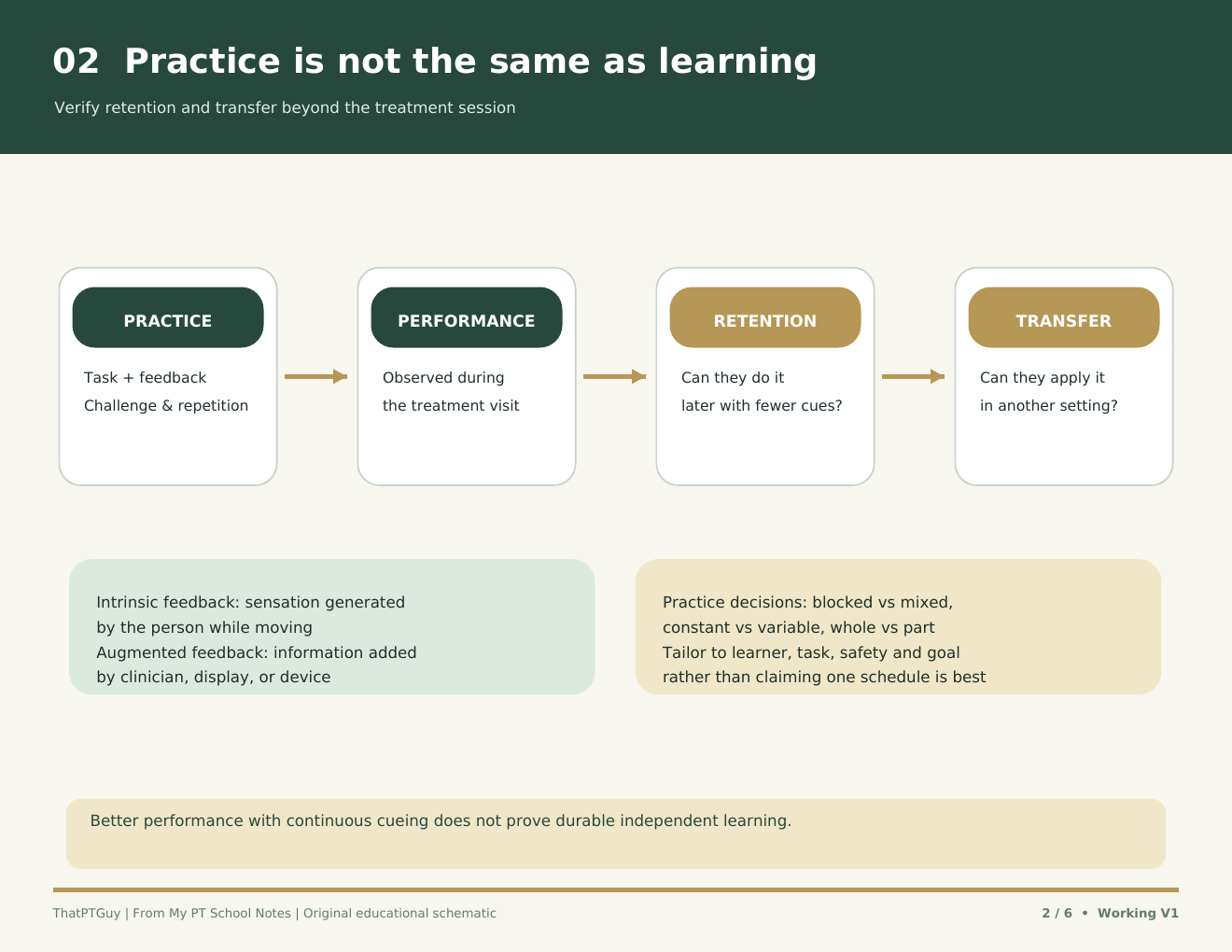
The big idea
Performance is what happens during a practice session. Learning is an inferred, more durable change that can be assessed through retention or transfer. A patient who moves faster after ten cued repetitions may be performing better because of the cue, not necessarily because the skill will hold up next week without it.
Motor learning includes explicit knowledge (conscious instructions and facts) as well as implicit or procedural learning (skills increasingly carried out with less deliberate attention). Fitts and Posner’s cognitive, associative, and autonomous stages offer a useful descriptive model; stages overlap and do not follow a fixed timetable.
Practice Options
Blocked practice repeats one version of a task and may help early success. Random or interleaved practice mixes different tasks or versions and may support adaptation for some learners. Constant practice keeps conditions similar; variable practice introduces different distances, speeds, settings, or surfaces. Whole-task practice preserves the functional goal; part-task practice is valuable when a meaningful component is too complex, provided it reconnects to the whole task.
Intrinsic feedback comes from the person’s own senses. Augmented feedback may convey knowledge of results (whether the goal was achieved) or knowledge of performance (how the movement was done). Immediate, frequent feedback may boost in-session performance but can also create dependence; adjust it to ability, task, safety, and learning stage.
Clinical Connection
In sit-to-stand practice, first establish a safe pattern, then vary chair height, arm support, and object carrying. Retest without the prompt later and observe a transfer to a real living-area seat.
Pause and apply it
If someone performs perfectly when cued, what would you test next week without the cue?
Try identifying the task goal, the movement strategy, and what you would measure before choosing an intervention.
A common point of confusion
There is no universal ‘random beats blocked’ or ‘never give feedback’ rule. Use learning goals and measured response.
Source notes and learning scope
Based on my original class notes: Motor Learning and Recovery of Function. This independently reorganized learning chapter is not a textbook reproduction, individualized treatment instruction, or NPTE guarantee. Compare it with your own coursework and current evidence.

