
FROM MY PT SCHOOL NOTES · NEUROLOGY · UNIT 1 · CHAPTER 01
How is the nervous system organized?
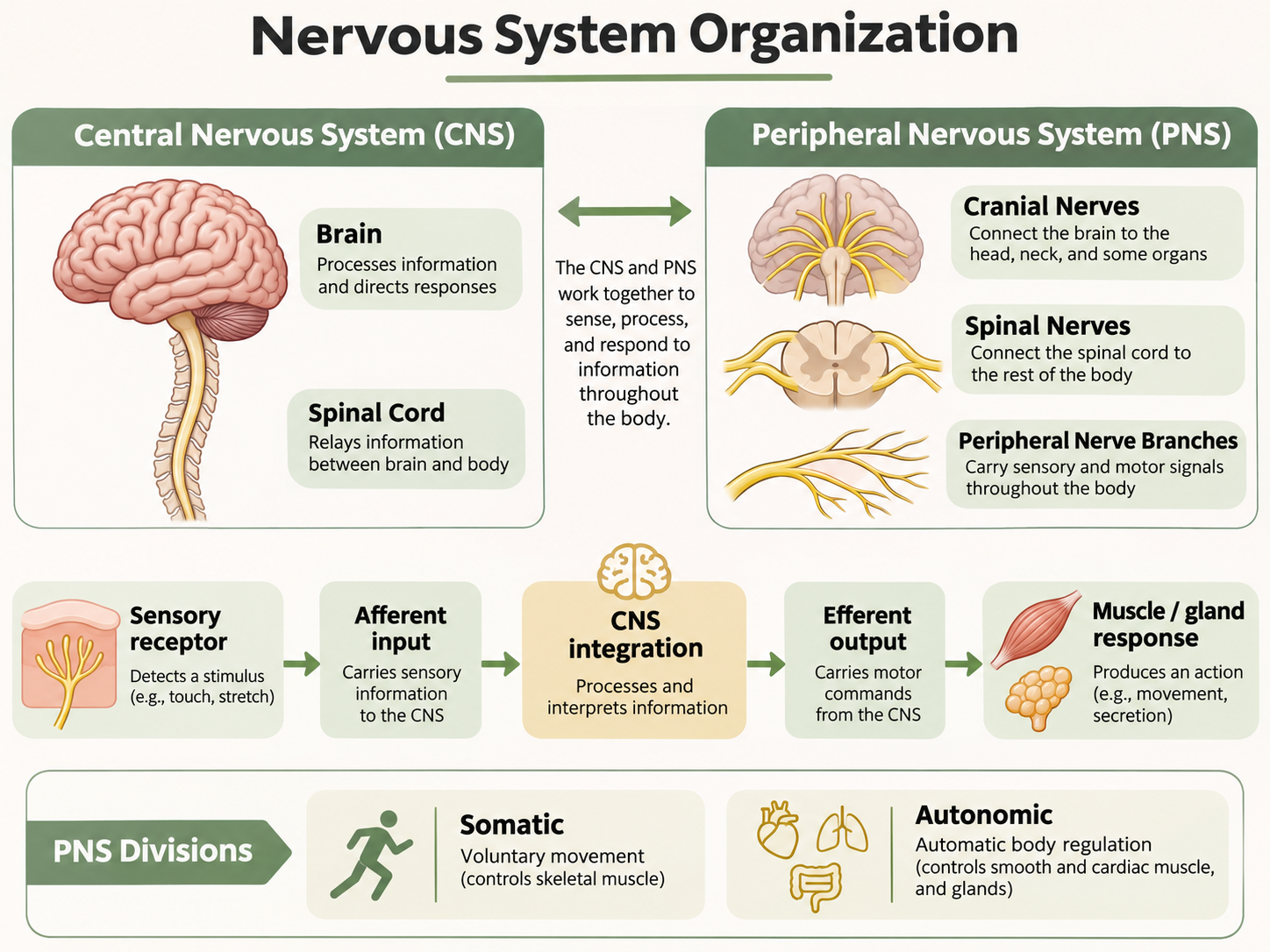
A neurological examination makes more sense when you know where information enters, how it is processed, and where motor commands leave. Start with an organizing map—not a list of structures to memorize.
Understand the essentials
Two divisions, one connected system
The central nervous system (CNS) consists of the brain and spinal cord. The peripheral nervous system (PNS) includes nerves and ganglia outside the CNS. They work as a network: sensory signals travel centrally, are integrated with goals and prior information, and may contribute to movement or autonomic responses.
Sensory (afferent) pathways carry information toward the CNS; motor (efferent) pathways carry commands toward effectors. Somatic pathways support perception and skeletal movement, while autonomic pathways regulate functions such as heart rate, vascular tone and organ activity. These divisions interact during nearly every functional task.
What a neuron contributes
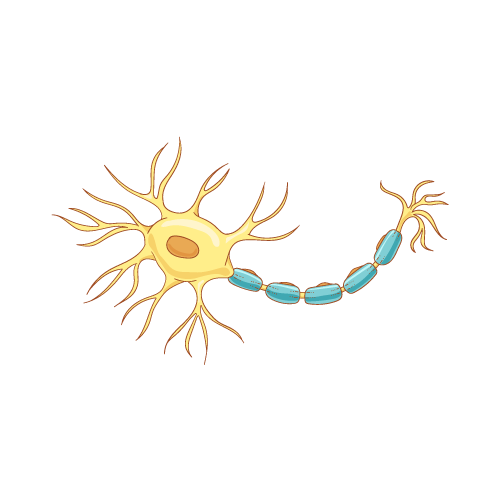
Dendrites mainly receive information; the cell body supports metabolism and integration; the axon carries action potentials; and terminals communicate at synapses. Many neurons are multipolar. Some primary sensory neurons are pseudounipolar, with a peripheral and central branch. Structure supports function, but circuit behavior depends on connections rather than a single cell.
Glial cells matter too. Astrocytes help maintain the neural environment; oligodendrocytes myelinate multiple CNS axon segments; Schwann cells provide myelin support in the PNS; microglia participate in immune surveillance. Myelin generally increases conduction efficiency through saltatory conduction between nodes of Ranvier.
Trace one task from stimulus to response
Imagine stepping onto an uneven surface. Cutaneous and proprioceptive afferents signal the change; spinal circuits, the brainstem, cerebellum and cortex contribute to rapid adjustments; descending pathways influence spinal motor neurons; and peripheral motor axons activate muscle. Vision, vestibular input, attention and prior practice also influence the result.
The point is not that the brain waits for every message before acting. Spinal reflexes, feedforward control and multiple parallel pathways help movements stay efficient and adaptable.
What changes for a physical therapist?
When a patient has reduced foot sensation and unstable gait, knowing the difference between absent peripheral input and impaired central integration guides your next questions. Ask whether weakness, sensation, coordination, cognition and environmental challenge fit the same explanation. A system map is more useful than assuming every balance deficit is ‘muscle weakness.’
Try the reasoning
A person senses a pebble under the foot but cannot rapidly adapt step placement. Does intact plantar sensation prove the entire sensorimotor system is intact?
Answer: No. Detecting the stimulus is only part of the process. Examine strength, proprioception, postural reactions, timing, coordination, vision and task context rather than assigning the problem to one structure.
Check your understanding
Can you identify the sensory receptor, afferent pathway, central processing elements, efferent pathway and effector in a sit-to-stand response?
Original lecture sources: 1 Intro to Nervous System.pdf; 2 Intro to Neuroscience .pdf; 6 Electrical Signalling.pdf; 7 Synaptic Transmission.pdf.. Adapted into independent educational wording; diagrams and paid-companion cross-references are in preparation. Not a patient-specific diagnosis or care plan.

