
FROM MY PT SCHOOL NOTES · NEUROLOGY · UNIT 1 · CHAPTER 03
What do the cortex, cerebellum and basal ganglia contribute?
Different neural networks contribute distinct pieces of skilled movement. Clinical patterns are more informative than treating each brain region like a single on/off switch.
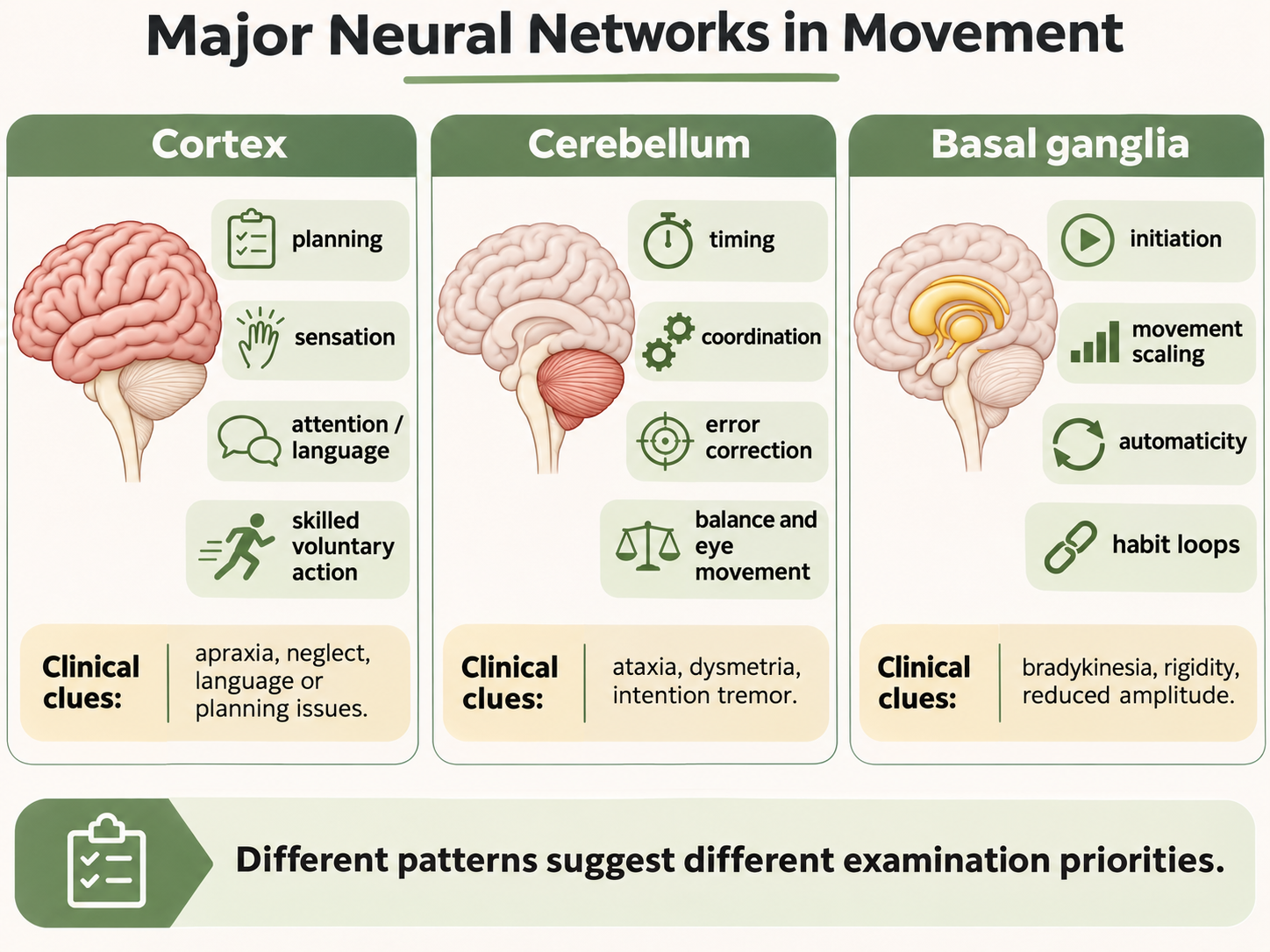
Understand the essentials
Cortex: goal-directed action, sensation and cognition
The frontal motor network helps plan and execute voluntary actions. Somatosensory and parietal networks interpret body and spatial information. Other cortical networks support attention, language, perception, visual processing and executive control.
After cortical injury, look beyond muscle strength. Aphasia can limit communication; neglect or field loss can alter navigation; apraxia can impair performance of a learned skilled task despite sufficient basic movement. These phenomena are not interchangeable.
Cerebellum: coordination and error-based adjustment
The cerebellum helps compare expected and actual movement consequences, supports timing and movement adaptation, and contributes to gaze and balance. Damage may produce dysmetria, decomposition of movement, intention tremor or ataxic gait.
Cerebellar signs often affect the side of the body ipsilateral to the injured cerebellar hemisphere, but anatomy and clinical presentations vary. During examination, distinguish poor coordination from weakness, impaired sensation, visual deficits and medication effects.
Basal ganglia: movement selection and scaling
Basal-ganglia circuits help regulate the initiation, selection and scaling of actions as well as habitual and cognitive processes. Parkinsonian patterns commonly include bradykinesia, rigidity, reduced movement amplitude and impaired automaticity; other basal ganglia disorders can feature excessive involuntary movement.
The basal ganglia interact extensively with thalamocortical and brainstem networks. They do not simply ‘start movement’ while the cerebellum ‘controls balance’; both participate in broader distributed systems.
What changes for a physical therapist?
Compare the patient’s task rather than the textbook labels. Reduced movement amplitude with trouble initiating steps, irregular target-reaching with dysmetria, and difficulty finding objects in half of space suggest different examination priorities even if all patients report that walking is ‘off.’
Try the reasoning
During reaching, a patient consistently overshoots a target and has irregular timing, but primary strength testing is close to normal. What is the better next observation?
Answer: Assess coordination, vision, sensory feedback and functional reach under controlled conditions. Dysmetria can suggest cerebellar involvement, but does not independently establish the lesion location.
Check your understanding
How would you explain the difference between reduced amplitude, ataxia and apraxia without equating them to weakness?
Original lecture sources: 5 Cortex Higher Functions.pdf; 3 Cerebellum.pdf; 4 Basal Ganglia.pdf; 10 Brainstem Lecture.pdf.. Adapted into independent educational wording; diagrams and paid-companion cross-references are in preparation. Not a patient-specific diagnosis or care plan.

