
FROM MY PT SCHOOL NOTES · UNIT 1 · CHAPTER 01
Why prescribe an orthosis in the first place?
An orthosis is an external device intended to alter support, load, alignment or movement. Before naming a brace, identify what the person cannot do safely and what mechanical change could help.
The key concepts
Start with function, not a catalog
Orthoses may stabilize an unstable joint, help substitute for insufficient muscle control, change the timing of movement, unload irritated tissue or protect healing structures. These goals can conflict. A rigid support may reduce motion while increasing weight, energy cost or difficulty with dressing. The lecture introduces the PT, orthotist and physician as complementary members of an orthotic team; device fabrication and modification decisions require appropriate training and communication.
A practical prescription discussion begins with a meaningful task. Is the problem foot clearance during swing, knee collapse in stance, pressure beneath an insensate foot, hand positioning, or medically ordered spinal motion restriction? The same diagnosis can lead to different device choices.
Connect the orthosis to external forces
A brace changes forces and moments across the body by acting through contact surfaces and leverage. The longer the effective moment arm, the less force may be needed to create a given corrective moment; pressure distribution and comfort still matter. The traditional three-point pressure concept is useful for learning how one primary corrective force and two counterforces can influence a segment, but real braces involve multiple three-dimensional contacts and changing gait forces.
Ask whether a device must allow rather than block motion. Orthoses can limit excessive movement while enabling a desired activity; excessive stiffness may impair advancement of the body over the planted foot.
Visualize the three-point pressure system
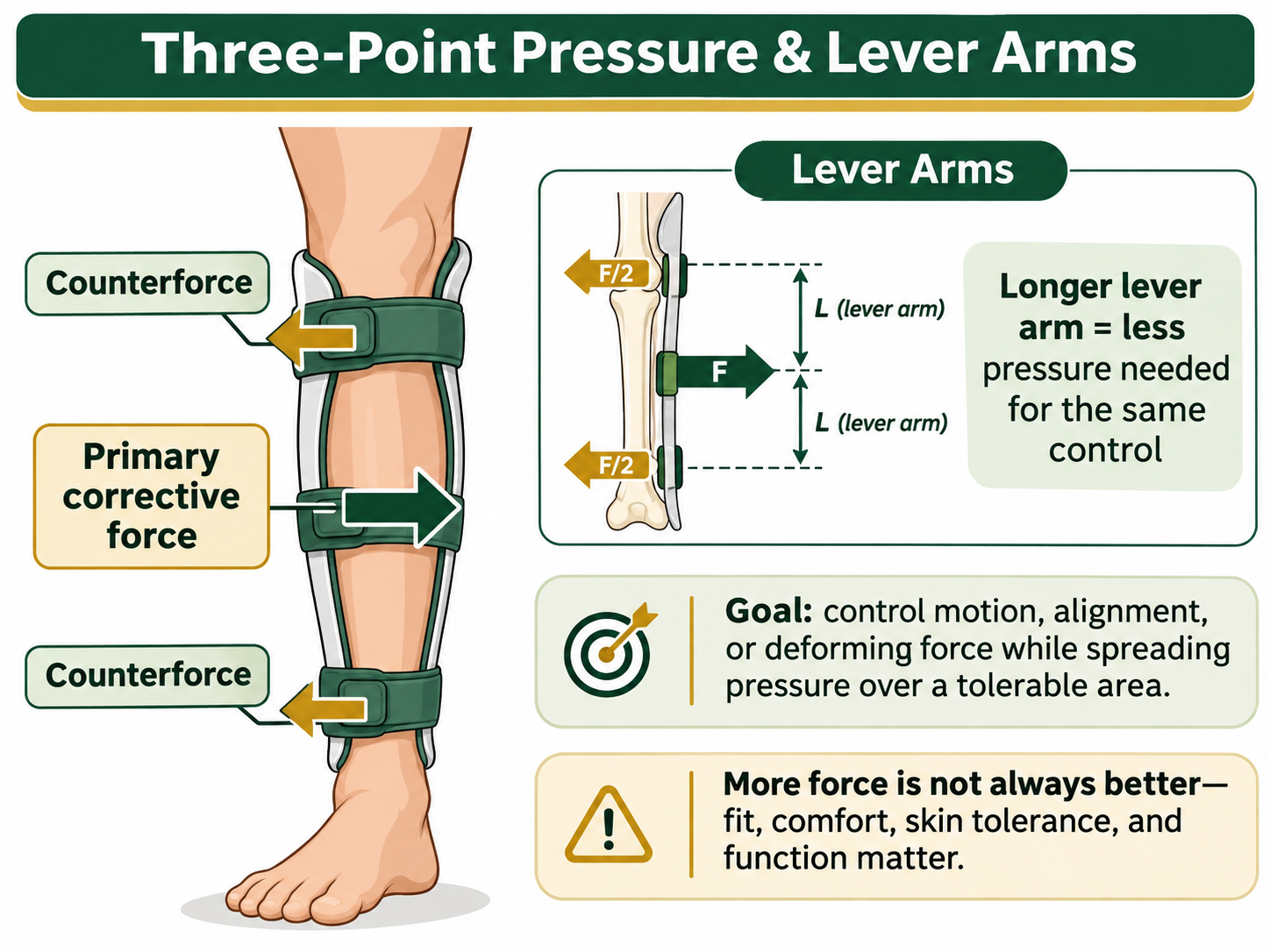
This schematic illustrates an idealized three-point force system. Increasing a lever arm can reduce the force needed for an equivalent corrective moment, but actual skin pressure depends on contact area, tissue tolerance, fit, shear and movement—not leverage alone.
Plan a meaningful trial
Record baseline task performance, relevant ROM, strength, sensation, skin status, pain, balance and footwear. Observe the same task with a proposed orthosis and look for improvement, compensations or new problems. Include the person’s ability to put it on and tolerate it. A device is successful when it improves the intended outcome without unacceptable trade-offs.
Quick comparison
| Primary goal | Example of the needed effect |
| Stability | Reduce uncontrolled knee collapse during stance |
| Clearance | Improve foot position for swing |
| Protection | Limit loading on a healing or insensate region |
| Participation | Enable a meaningful daily task safely |
Clinical reasoning
A patient after stroke catches the toes during swing but also hyperextends the knee in stance. Is ‘any foot-drop brace’ a sufficient choice?
Reasoning: No. Analyze swing clearance and stance knee mechanics together. Device alignment, stiffness, ankle range and functional testing may all change the choice.
Check your understanding
How would you establish a measurable goal before recommending an orthosis?
Source lecture(s): 1 Intro.pdf; 4 Principles of LE Orthoses .pdf. Evidence update: This chapter explains the original course principles. Disease-specific evidence and device decisions are added in later chapters.
These are focused lessons drawn from my PT-school notes, with later guidance identified separately. They are not official coursework, device prescriptions or patient-specific treatment protocols.

