
FROM MY PT SCHOOL NOTES · UNIT 1 · CHAPTER 02
Which foot and gait mechanics matter for orthotic design?
Before choosing a posting, shoe or brace, examine what the rearfoot, midfoot and forefoot actually do during a task—and what needs to change.
The key concepts
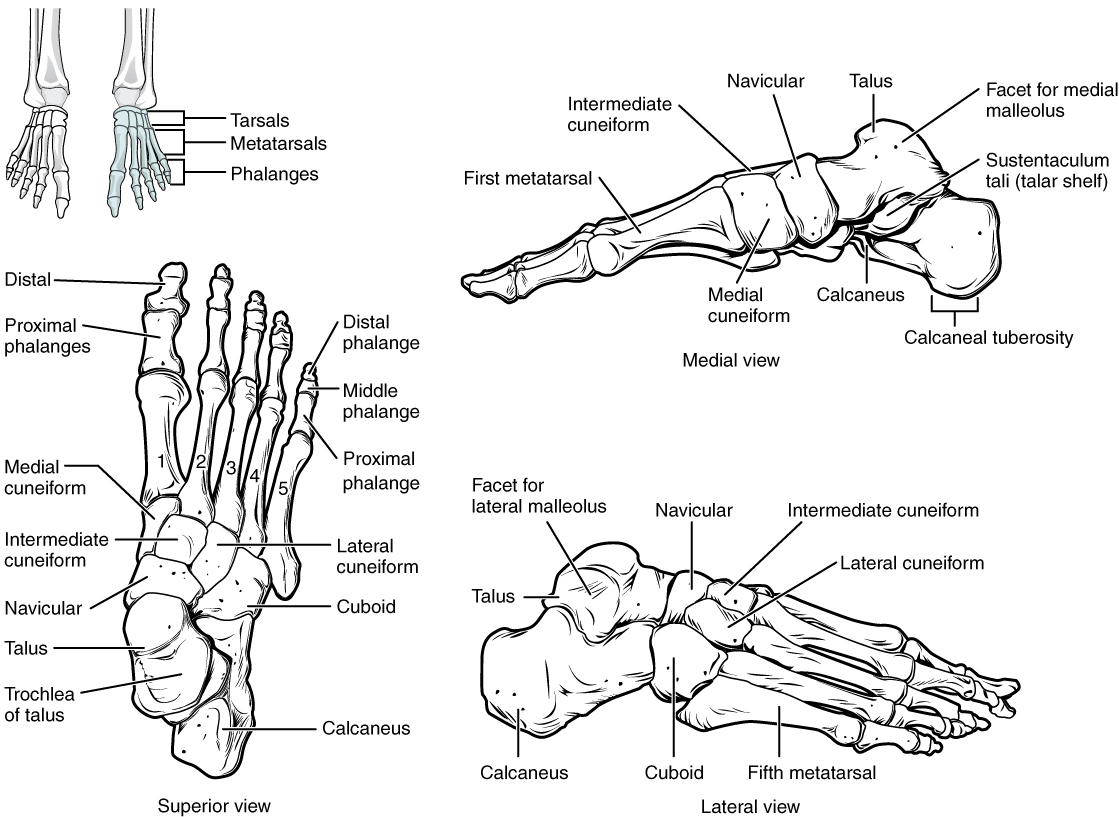
Remember the three-dimensional foot
The subtalar and midtarsal joints permit coupled movement across multiple planes, while the foot must adapt to uneven terrain and later become a reasonably stiff lever for push-off. The uploaded foot-review lecture uses simplified ‘all-or-nothing’ triplanar rules; in a real person, a wedge or post does not reliably block all foot movement. Form a hypothesis and test it rather than predicting a fixed correction from arch shape alone.
Assess ankle dorsiflexion, hindfoot and forefoot position, first-ray and great-toe demands, mobility, pain and sensation. Structural alignment can influence loading, but foot posture does not dictate a diagnosis or the correct insert by itself.
Look across the gait cycle
During loading response, the foot and ankle accept weight and assist shock absorption. During midstance, the tibia advances over the foot. Near terminal stance and pre-swing, forefoot and toe mechanics contribute to progression. An insole, heel modification or stiff rocker sole can change timing and loading; a brace that blocks the ankle rocker may transfer demand to the knee or hip.
Compare a patient’s walking without and with footwear or orthosis at the speed and terrain that matter. A smoother clinic gait does not automatically mean less pain over a full workday.
Visualize the three gait rockers
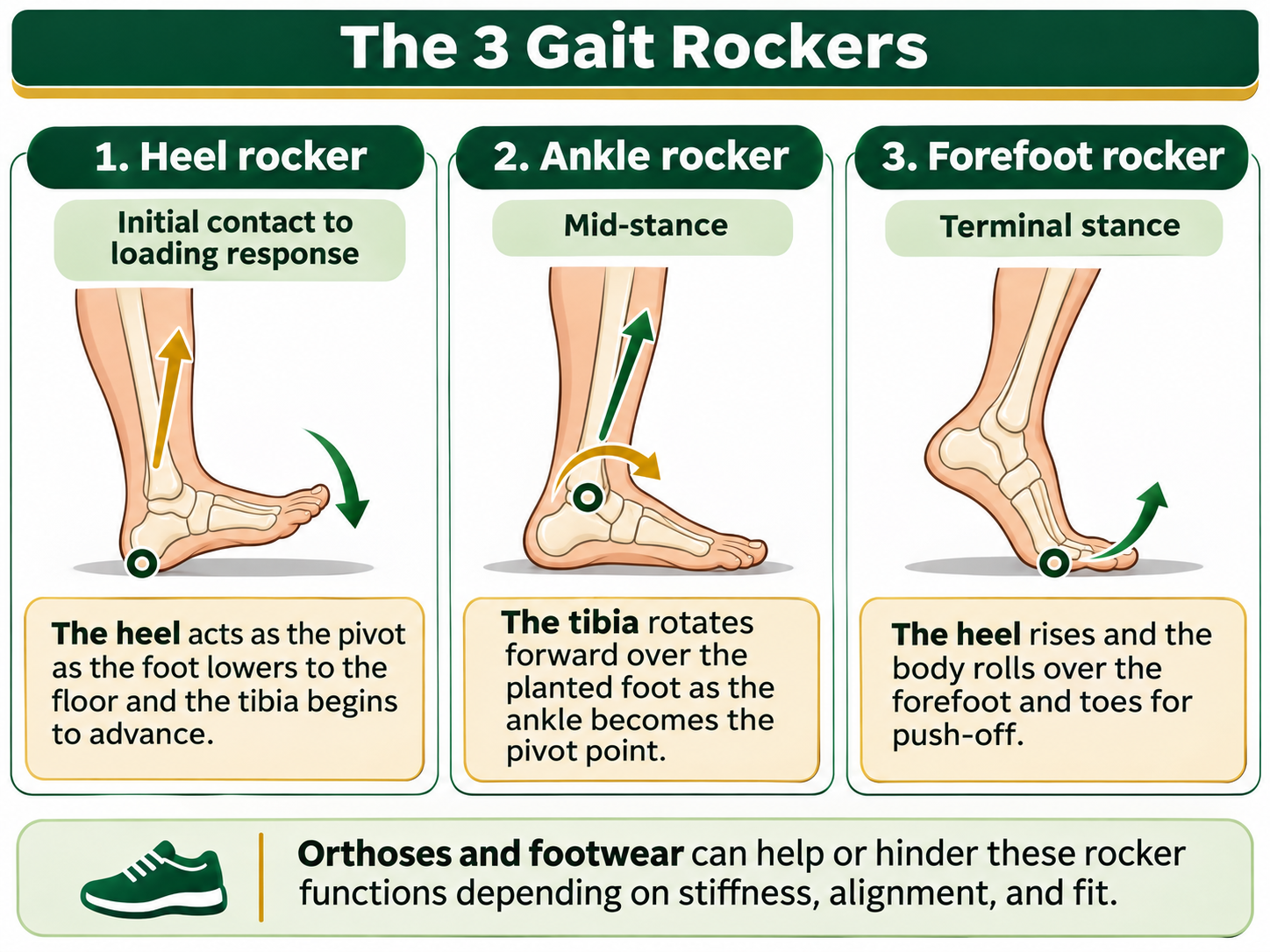
The diagram simplifies stance into heel, ankle and forefoot rockers. These functions overlap across walking phases, and the transitions vary with speed, pathology and footwear. Consider how a stiff sole or AFO changes tibial progression and forefoot rollover.
Choose a testable mechanical target
If the complaint is painful forefoot loading, an unloading or rocker hypothesis may be reasonable after checking shoe fit and medical contraindications. If the issue is ankle instability, assess control, footwear and balance rather than assuming every foot needs to be held in neutral. The orthotist translates the agreed goal into materials and geometry, while PT evaluates activity performance and progression.
Quick comparison
| Rearfoot | Hindfoot alignment, shock acceptance and contact |
| Midfoot | Load sharing, arch mobility and surface adaptation |
| Forefoot | Terminal-stance loading and toe-off mechanics |
| Footwear | Fit, heel height, sole stiffness and rocker characteristics |
Clinical reasoning
A patient with limited dorsiflexion takes short steps and rises onto the forefoot early. A very rigid insert is proposed to ‘correct pronation.’ What should be checked first?
Reasoning: Examine actual ankle mobility, gait timing, pain and shoe mechanics. The proposed insert may not address the limiting factor.
Check your understanding
Why can a shoe or orthosis change knee mechanics even when it does not cross the knee?
Source lecture(s): 2 Foot Review.pdf; 3 Foot Orthotics.pdf. Evidence update: The older lecture’s exact subtalar-axis angles and fixed posting rules are teaching models, not patient-specific predictions.
These are focused lessons drawn from my PT-school notes, with later guidance identified separately. They are not official coursework, device prescriptions or patient-specific treatment protocols.


