
FROM MY PT SCHOOL NOTES · MOTOR CONTROL · CHAPTER 06
How should a PT evaluate movement problems?
In this chapterThe big ideaExampleClinical Connection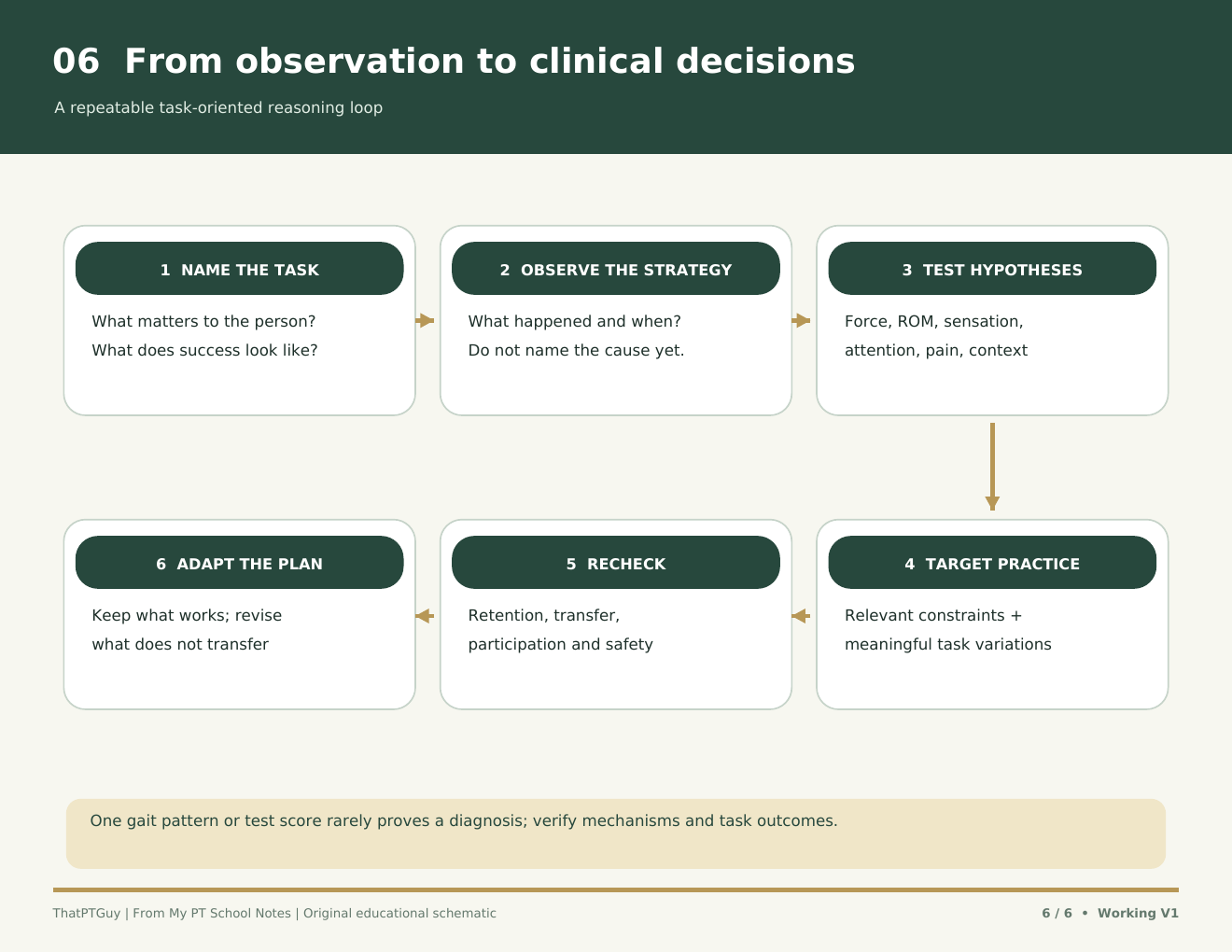
The big idea
A task-oriented examination considers three connected levels: function/participation, the strategy used to perform a task, and the impairments that may constrain that strategy. A functional score tells us what happened under the test conditions; observation and targeted assessment help explain why.
A useful reasoning sequence is: (1) identify an activity the person values; (2) compare what they do in the clinic with what participation requires; (3) describe the observed movement pattern without assuming its cause; (4) list plausible explanations; (5) choose a few tests that separate them; (6) develop targeted practice and re-evaluate in context. Environmental barriers, confidence, fatigue, and cognition are not afterthoughts.
Example
A patient takes several steps to turn. Possible constraints include reduced balance reserve, difficulty scaling steps, limited neck/trunk rotation, fear, visual-perceptual issues, pain, or the width of the pathway. The exam should not jump directly to ‘weak hip abductors.’
Clinical Connection
Write functional goals around activities and participation—e.g., turning through a hallway safely while carrying a light object—rather than isolated impairment targets alone. Use validated measures relevant to diagnosis and setting while watching quality and strategy.
Pause and apply it
A patient takes six steps to turn. What could explain this besides leg weakness?
Try identifying the task goal, the movement strategy, and what you would measure before choosing an intervention.
A common point of confusion
‘Capacity’ on a standardized clinic task does not automatically equal performance in daily life. Also, one observed compensation is not necessarily harmful if it enables safe, independent function.
Source notes and learning scope
Based on my original class notes: A Conceptual Framework for Clinical Practice; Clinical Management of Mobility; Clinical Management UE. This independently reorganized learning chapter is not a textbook reproduction, individualized treatment instruction, or NPTE guarantee. Compare it with your own coursework and current evidence.

