
FROM MY PT SCHOOL NOTES · MOTOR CONTROL · CHAPTER 07
How does postural control work?
The big idea
Postural control allows orientation and stability of the body in space. The base of support, center of mass (COM), and center of pressure (COP) help describe how forces and body position are managed. COP is a measurement of ground reaction force distribution, not simply the same point as the body’s COM. Stability depends on more than keeping the COM motionless.
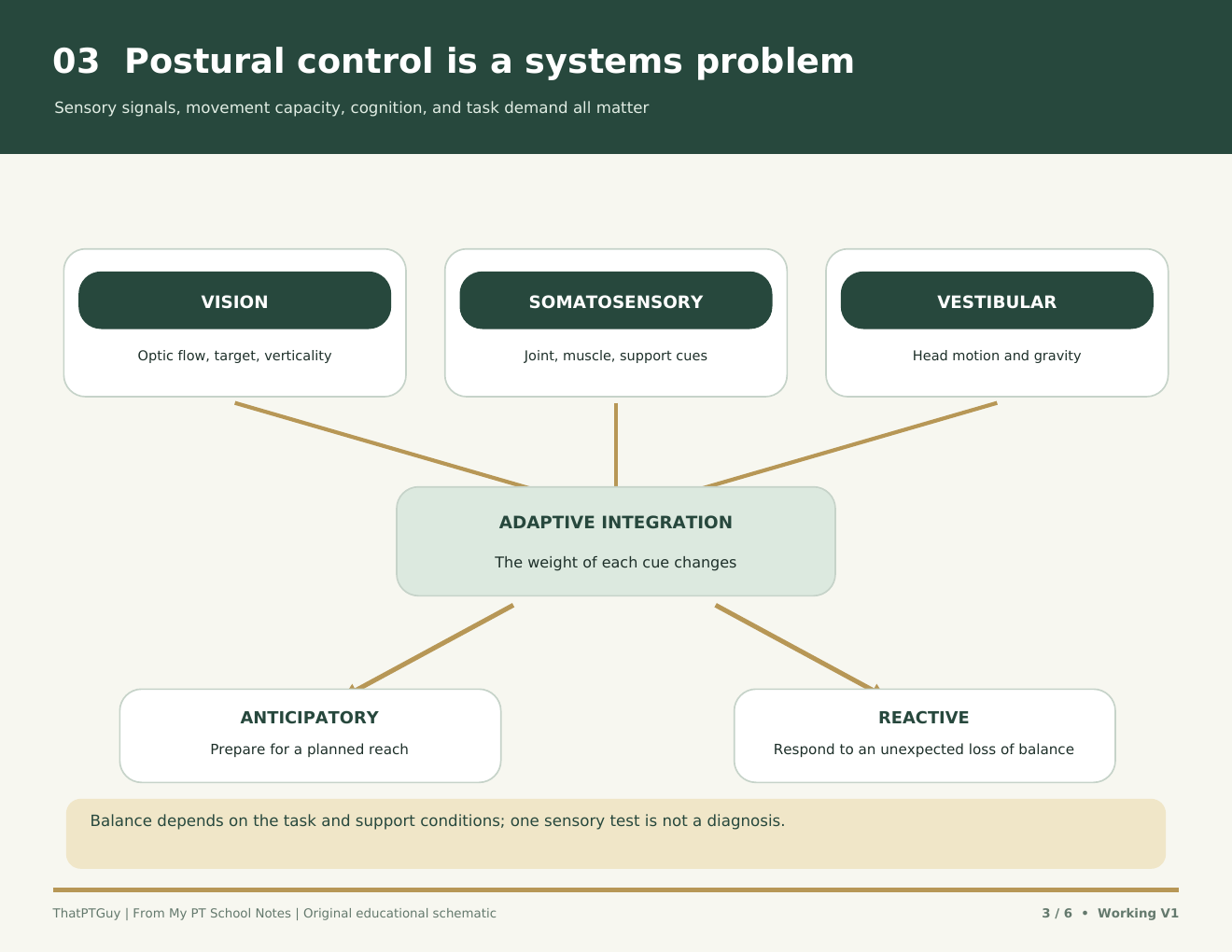
Three major sensory channels contribute: somatosensation informs body position and support contact; vision provides information about the surrounding environment and motion; and vestibular input helps encode head movement and orientation relative to gravity. Their relative weighting adapts to the reliability of each channel and task demands. A soft surface or darkness can reveal reliance on one channel, but neither condition alone diagnoses a vestibular or neurologic disorder.
Stability can be maintained through smaller ankle-associated responses, larger hip-associated responses, and changes in base of support such as stepping or reaching. These are response patterns, not rigid stages everyone must follow. Anticipatory postural adjustments prepare for self-generated movement; reactive responses respond to unexpected disturbances.
Clinical Connection
Ask what the patient needs to do: stand quietly, reach beyond arm’s length, turn, step after a perturbation, or walk while talking. These are different balance demands.
Pause and apply it
Why might carrying a heavy bag make balance more difficult even on a flat floor?
Try identifying the task goal, the movement strategy, and what you would measure before choosing an intervention.
A common point of confusion
Don’t conflate the COM, center of gravity, COP and base of support. A photograph of body sway is not a complete balance assessment.
Source notes and learning scope
Based on my original class notes: Normal Postural Control; Abnormal Postural Control. This independently reorganized learning chapter is not a textbook reproduction, individualized treatment instruction, or NPTE guarantee. Compare it with your own coursework and current evidence.

