
FROM MY PT SCHOOL NOTES · MOTOR CONTROL · CHAPTER 08
How does balance change across the lifespan?
The big idea
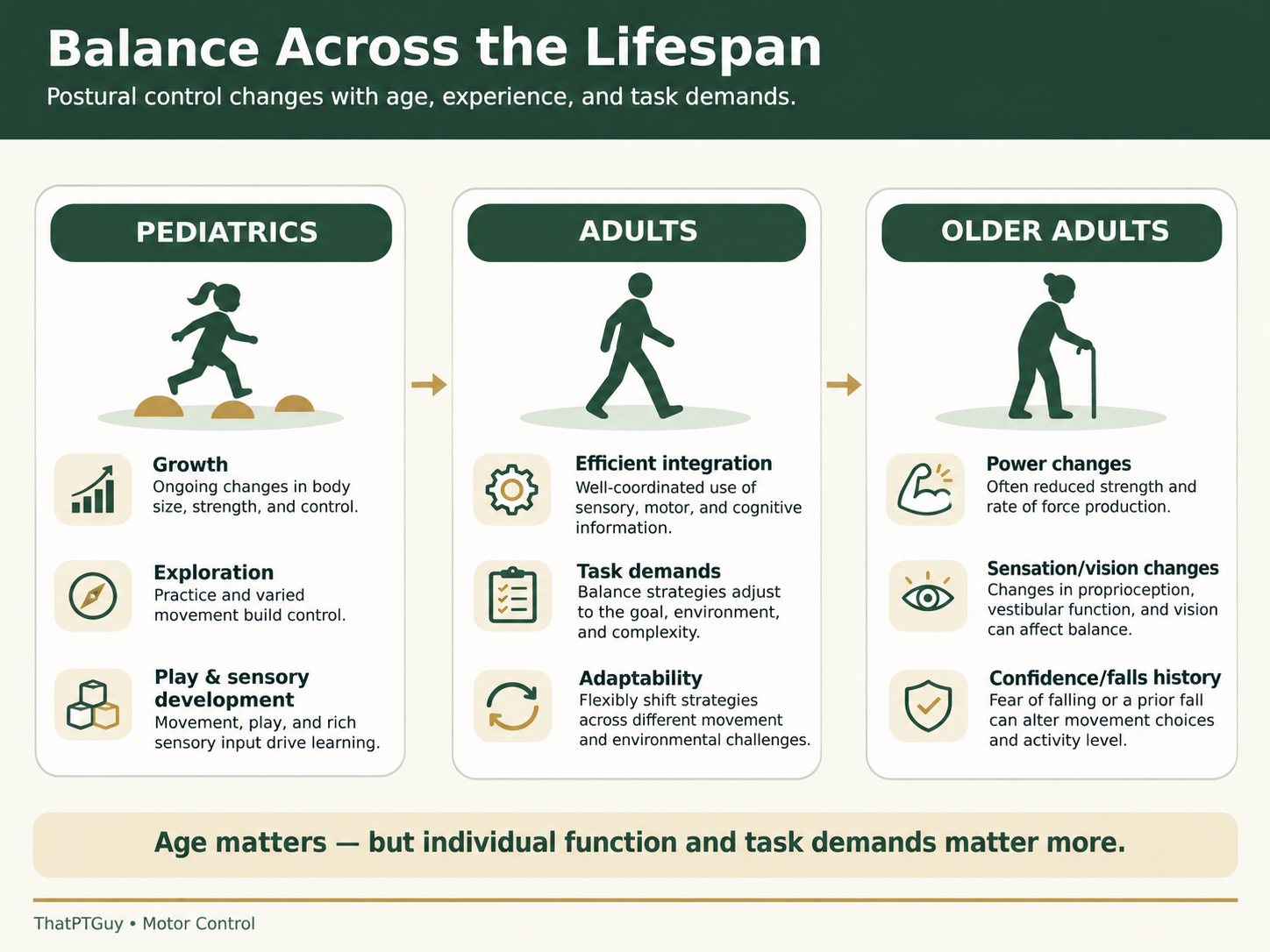
Postural control develops through maturation, growth, exploration, and experience. Children are learning to coordinate a changing body, interpret sensory inputs, and manage new tasks. Early milestones are useful observational context but should not be treated as a single fixed timetable or used to diagnose delay without a complete developmental evaluation. Reflexes may be assessed in context, but emerging independent control is not adequately explained by reflex ‘integration’ alone.
With aging, changes in muscle power, joint capacity, somatosensory function, vision, vestibular function, cognition, activity levels, and medication exposure can alter balance. Healthy older adults vary considerably; aging does not make loss of balance inevitable. Fear of falling can change the way a person moves and may reduce participation, which can amplify deconditioning.
A useful examination considers steady-state stability, anticipatory adjustments, reactive stepping, sensory integration, dual-task demands and functional endurance. Someone who stands well in the clinic may still have trouble carrying groceries across grass at dusk.
Clinical Connection
In pediatrics, emphasize play and meaningful varied environments. In older adults, screen falls history and circumstances, investigate modifiable contributors and match exercise to function. Use the updated 2025 APTA Geriatrics falls guideline for community-dwelling older adults rather than assuming historical handout cutoffs are current.
Pause and apply it
Which variables matter when a child reaches an unfamiliar milestone, or an older adult begins avoiding uneven ground?
Try identifying the task goal, the movement strategy, and what you would measure before choosing an intervention.
A common point of confusion
Ages and percentages from older lecture slides often describe small cohorts or typical patterns, not universal standards. Don’t treat one balance value as a complete measure of fall risk.
Source notes and learning scope
Based on my original class notes: Development of Postural Control; Aging and Postural Control; Life Span Mobility Pediatrics; Life Span Mobility Geriatrics. This independently reorganized learning chapter is not a textbook reproduction, individualized treatment instruction, or NPTE guarantee. Compare it with your own coursework and current evidence.

