
FROM MY PT SCHOOL NOTES · MOTOR CONTROL · CHAPTER 09
How should balance impairments be assessed and retrained?
The big idea
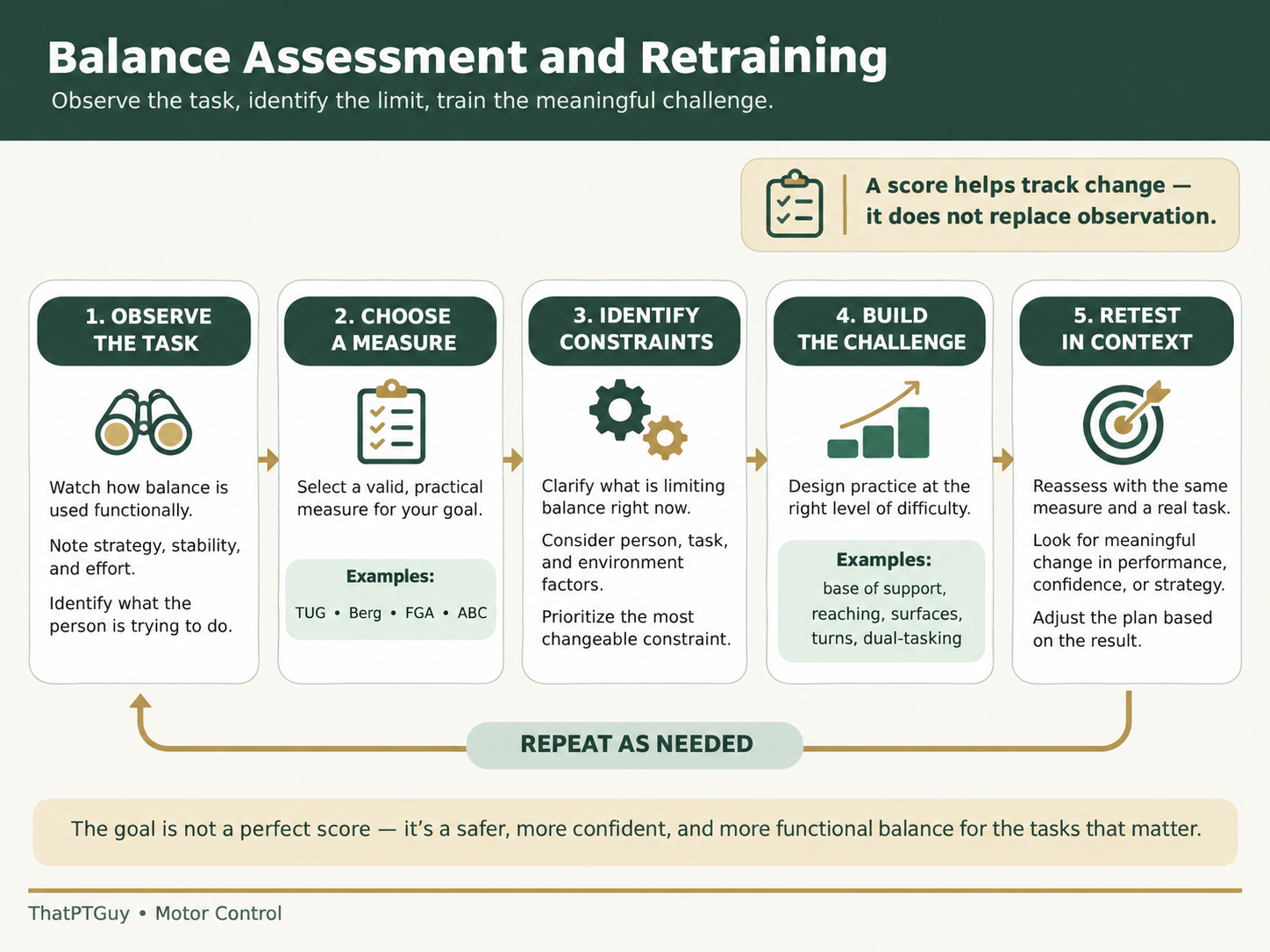
Balance intervention should identify the relevant task failures and train the systems and skills required to manage them. Examine alignment, strength and ROM, sensory organization, anticipatory control, reactive stepping, gait under environmental challenge, dual-task ability, confidence, and the consequences of previous falls. A score can track change but should not replace observation of how the task is accomplished.
Measures In Context
Timed Up and Go, Berg Balance Scale, Functional Gait Assessment, Activities-specific Balance Confidence Scale, sensory interaction tests, and other measures answer different questions. Choose among them by diagnosis, baseline ability, setting, published testing protocol, and the outcome you want to monitor. Their risk cutoffs and minimal detectable/clinically important changes may differ by sample and population; avoid universal cutoffs or ‘safe/unsafe walker’ labels.
Intervention Design
Build sufficient challenge with appropriate guarding, then vary base of support, reach direction, surface characteristics, head turns, obstacle negotiation, steps, and real participation tasks. Include strength or power work when capacity limits functional balance, plus specific practice of the situations that matter. Progress through meaningful complexity, not simply through balancing on ever more unstable equipment. For community-dwelling older adults, exercise-based, tailored fall-risk management should align with current guidance.
Clinical Connection
For someone falling while turning to answer a family member, train turns within safe guarding, verify whether sensory or attention demands worsen performance, and practice conversational tasks when appropriate.
Pause and apply it
Is an excellent quiet-standing test enough to explain a fall during a quick turn?
Try identifying the task goal, the movement strategy, and what you would measure before choosing an intervention.
Source notes and learning scope
Based on my original class notes: Clinical Management of the Patient with a Postural Control Disorder; Abnormal Postural Control; Table of FOM. This independently reorganized learning chapter is not a textbook reproduction, individualized treatment instruction, or NPTE guarantee. Compare it with your own coursework and current evidence.
Current practice context (added to the class notes)
The 2025 APTA Geriatrics guideline for community-dwelling adults 65 and older recommends multifactorial fall-risk management and progressive, sufficiently challenging balance training within a multicomponent exercise program. Specific recommendations include volitional stepping and/or gait adaptability training. Education alone and resistance training alone are not substitutes for fall-prevention exercise.
2025 falls guideline (APTA) (additional evidence; not part of the original lecture file).

