
FROM MY PT SCHOOL NOTES · MOTOR CONTROL · CHAPTER 10
What are the events and demands of normal gait?
In this chapterThe big ideaPhases As QuestionsClinical Connection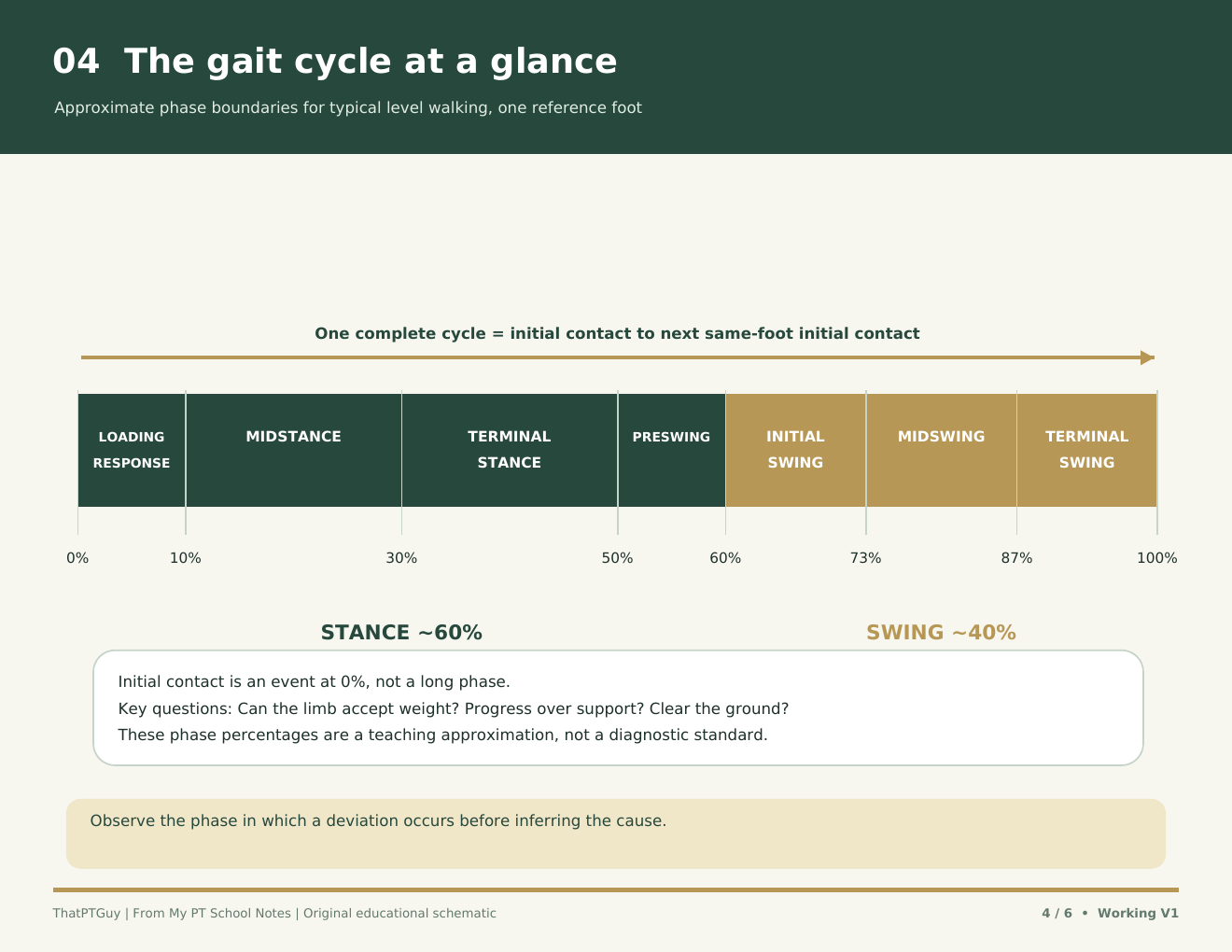
The big idea
A gait cycle runs from initial contact of one foot to the next initial contact of that same foot. In typical level walking, stance occupies roughly three-fifths of the cycle and swing about two-fifths, but pace, individual mechanics, and terrain change timing. Traditional eight-phase terminology: initial contact, loading response, midstance, terminal stance, preswing, initial swing, midswing, and terminal swing.
Phases As Questions
Initial contact and loading response: can the limb accept body weight with controlled ankle, knee and hip mechanics? Midstance: can the trunk and pelvis progress over a stable support limb? Terminal stance: can the limb trail while the tibia advances and the heel rises? Preswing: can the limb unload and prepare for advancement? Initial and midswing: can the limb shorten for clearance while moving forward? Terminal swing: can the limb prepare safely for the next contact?
The ankle rockers, knee control and hip/pelvic contributions matter because locomotion demands forward progression, stability and adaptability while limiting unnecessary energy cost. Small differences in foot contact do not by themselves establish pathology, and joint ROM values in historical charts are approximate descriptions of typical level gait.
Clinical Connection
Observe from multiple planes if feasible, at self-selected and relevant faster speeds. Record cadence, step symmetry and clearance, but connect observations to actual activities and the patient’s goals.
Pause and apply it
During which phase would you look for poor swing-foot clearance?
Try identifying the task goal, the movement strategy, and what you would measure before choosing an intervention.
A common point of confusion
A phase label identifies an interval, not necessarily the exact moment one muscle becomes active. Body-weight vectors describe external demands and do not reveal muscle activation without further analysis.
Source notes and learning scope
Based on my original class notes: Gait Analysis; Phases of Gait; Gait Echo Lectures 1–3; Normal Gait Chart; Normal Mobility. This independently reorganized learning chapter is not a textbook reproduction, individualized treatment instruction, or NPTE guarantee. Compare it with your own coursework and current evidence.

