
FROM MY PT SCHOOL NOTES · MUSCULOSKELETAL · CHAPTER 02
ROM and goniometry: what are you actually measuring?
ROM is the movement available at a joint—not the same thing as stretching. The test position, assistance and measurement method change what the result means.
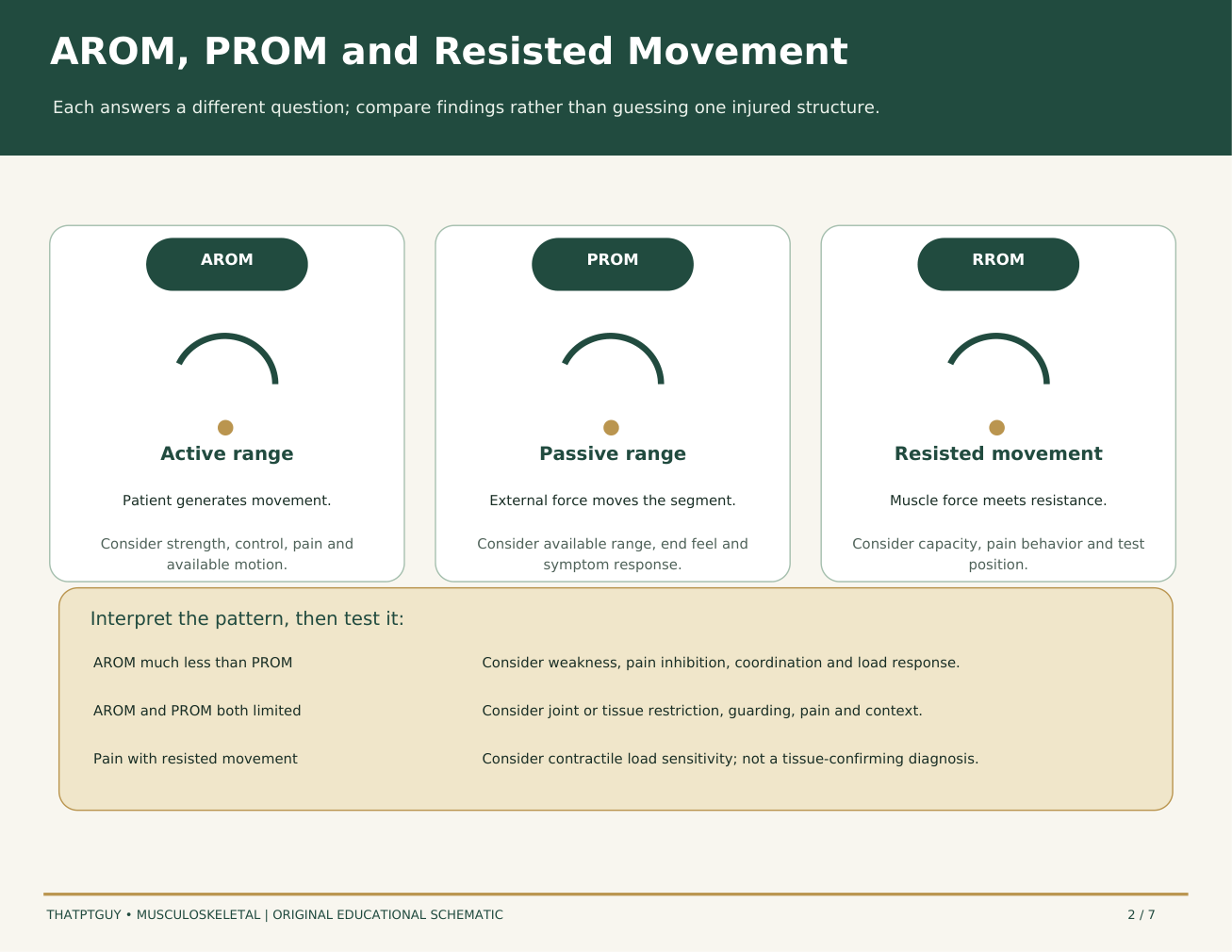
AROM, PROM, AAROM and resisted movement
- AROM: movement the patient produces—look at available range, symptoms, strategy and coordination.
- PROM: movement produced externally—compare available motion, pain response and tissue resistance.
- AAROM: patient movement with help—document the amount and source of assistance.
- Resisted movement: capacity and symptom response under a specified load; not a stand-alone tissue diagnosis.
A reproducible measurement checklist
- Keep the patient’s test position and stabilization consistent.
- Align the axis and both arms using identified bony landmarks.
- Record starting and ending angles with side, active/passive status and symptoms.
- Repeat with the same device and protocol when checking change over time.
A knee example: the axis is aligned with the lateral femoral epicondyle; the stationary arm follows the femur toward the greater trochanter; the moving arm follows the lower leg toward the lateral malleolus. Different lab protocols may measure knee flexion in supine or prone; keep the method consistent for comparison.
What a number cannot prove
Goniometry describes measured ROM, not the exact tissue limiting it. A small change can reflect normal measurement variation. The older lecture’s broad claims about passive movement and tissue healing should be read as historical course content, not guaranteed outcomes.
Try a quick decision
Knee extension reaches 0° passively, but actively remains 8° short. What possibilities should you explore?
Consider quadriceps activation, pain inhibition, coordination, swelling/effusion, fatigue and functional demands before assuming a fixed joint restriction. Document both active and passive methods and retest the task.
Original materials and additional evidence
ROM Lecture; Goniometry Lecture. Additional verification: the 2010 knee ligament-sprain clinical guideline’s measurement methods and the clinical review of goniometry reliability and validity.
Example knee measurement protocol · ROM reliability review
Illustration note: the recently approved Goniometry in Practice design is being corrected for body position and angle consistency before it is used here.
Where this came from
This lesson reorganizes themes from my own PT-school lecture/lab materials and identifies outside guidance separately. It is a personal study companion, not an official course, diagnostic protocol, or NPTE-pass promise. Compare details with your own materials and current practice guidance.

