
FROM MY PT SCHOOL NOTES · MUSCULOSKELETAL · CHAPTER 03
Joint mechanics and capsular patterns: useful models, not diagnoses
Learn the difference between observable movement and accessory joint motion, then decide what those findings can—and cannot—tell you about function.
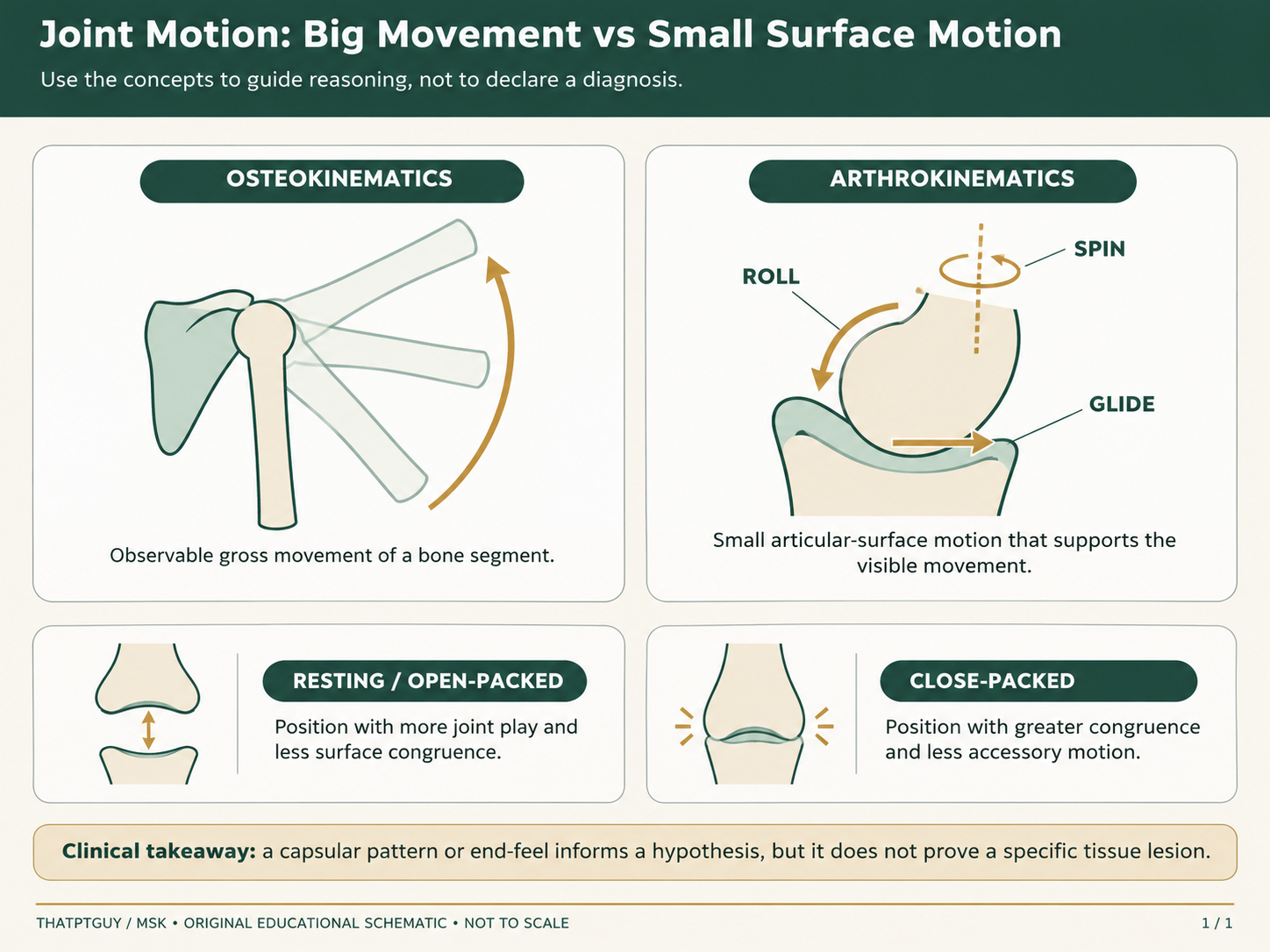
Osteokinematics versus arthrokinematics
Osteokinematics describes gross bone motion such as flexion, abduction and rotation. Arthrokinematics describes the roll, glide and spin occurring between articular surfaces. Standard goniometry measures an angle, not an accessory glide.
Understand the model’s limitations
The concave–convex rule predicts how roll and glide relate in simple models. Real joints have complex geometry and individual motion variation, so the rule does not identify a lesion or automatically prescribe the direction of manual treatment.
Capsular patterns in your lecture
The source lectures describe traditional patterns of loss across multiple passive movements—for example, greater external-rotation restriction than some other motions at the shoulder, or greater flexion than extension restriction at the knee. These are historical teaching patterns, not reliable stand-alone diagnoses. Pain, guarding, inflammation, surgery and other factors also alter motion.
End-feels and joint play
Soft, firm, hard and pain-limited (’empty’) are descriptive examination terms. Open-/close-packed positions refer to differing joint congruence and accessory play, but exact positions vary by joint and reference. Document symptom response and task improvement rather than concluding a specific capsular lesion from one end-feel.
Try a quick decision
Shoulder external rotation and elevation are both passively restricted. Can you diagnose adhesive capsulitis from that alone?
No. The pattern can inform a hypothesis, but compare symptom history, irritability, other active/passive findings, relevant medical factors and functional restriction. Additional assessment is needed before making a clinical diagnosis.
Original materials and rights note
Goniometry Lecture; ROM Lecture; Shoulder Arthrokinematics; Capsular Patterns. The uploaded capsular-pattern table is a scan of a copyrighted textbook table and was intentionally not reproduced here.
Where this came from
This lesson reorganizes themes from my own PT-school lecture/lab materials and identifies outside guidance separately. It is a personal study companion, not an official course, diagnostic protocol, or NPTE-pass promise. Compare details with your own materials and current practice guidance.
← ROM and goniometry · Foundations index
Continue: Next unit: Spine, Neck & Pelvis

