
FROM MY PT SCHOOL NOTES · MUSCULOSKELETAL · CHAPTER 07
Lumbar Pain, Leg Symptoms and Directional Preference
The lumbar lectures cover disc and facet mechanics, nerve-root anatomy, repeated movement and practical mobility tasks. A movement response guides a hypothesis; it cannot confirm a precise internal disc position.
What to assess
Begin with safety screening and meaningful activities such as walking, lifting, sitting, sleep or standing. Compare relevant lumbar movements, functional performance and neurologic findings when symptoms suggest nerve involvement.
Centralization and peripheralization
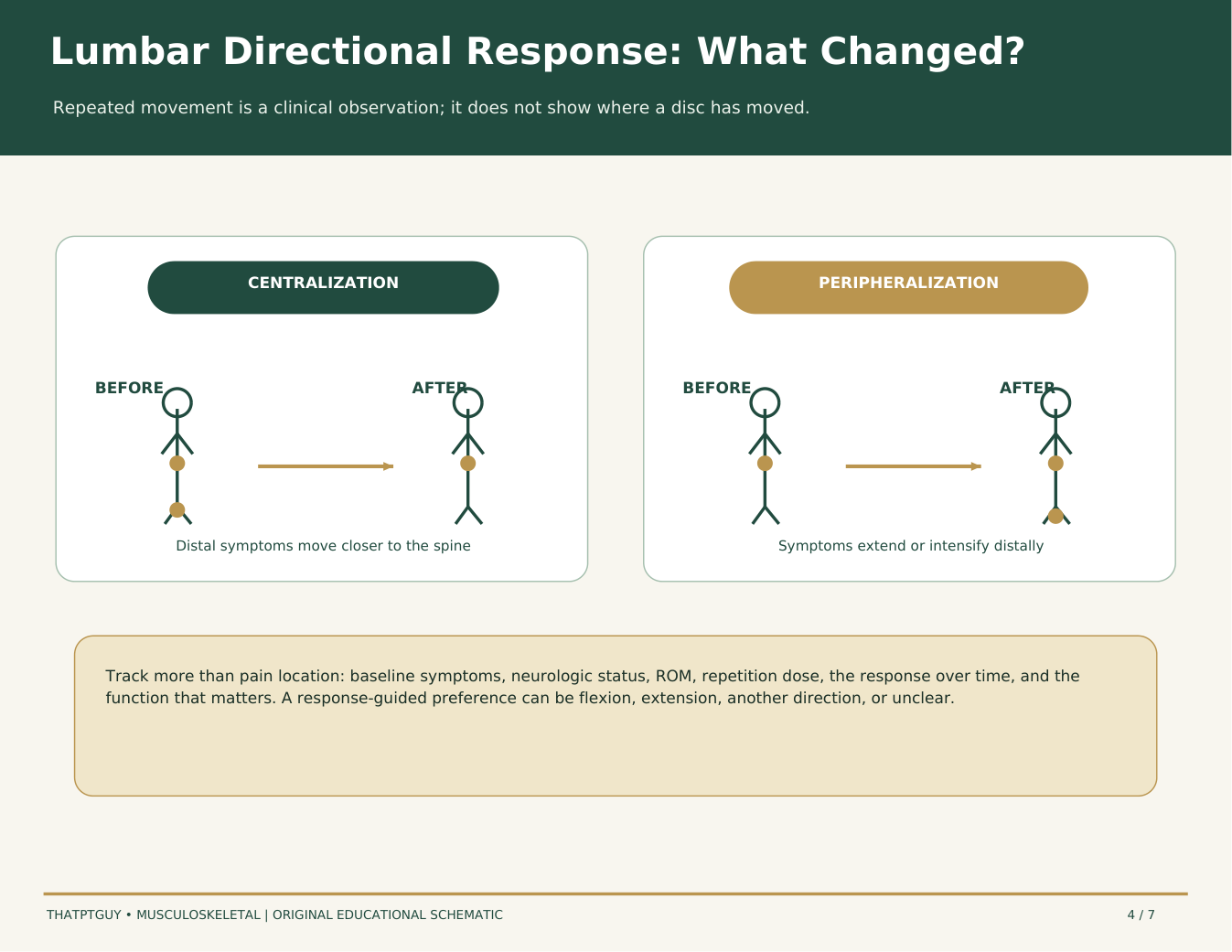
Centralization describes distal referred symptoms moving toward the spine during a repeated movement/position; peripheralization describes a distal spread. A directional preference may be flexion, extension, another direction or unclear. Track the dose, baseline, immediate and delayed responses and what happens to function.
Do not force extension on everyone
An old diagnostics handout says to ‘always work toward extension.’ Treat that as historical lecture shorthand rather than a current universal rule. A patient whose symptoms worsen or who responds better in flexion needs individualized decision-making.
What warrants urgent care?
New saddle sensory changes, bowel/bladder dysfunction or rapidly progressing lower-limb neurologic deficits can indicate a serious neurologic condition and need urgent medical assessment. Do not manage these as routine self-directed back exercises.
A key lecture-era limitation
Updated guidance: APTA/JOSPT 2021 low-back guideline supports symptom- and function-informed exercise rather than a single movement prescription.
External guidance and verification (separate from original notes)
Try a clinical question
Repeated extension reduces leg pain but increases central back discomfort. Is it automatically helpful?
Not automatically. Recheck neurologic findings, how persistent and tolerable the response is, whether leg symptoms continue to retreat, and the person’s target task; progress or alter testing based on the complete picture.
Original notes and scope
Lumbar Anatomy; Lumbar Spine Lab; McKenzie Lecture; Lumbar Pathologies; Lumbar Exam Diagnostics.
My PT-school class notes, independently reorganized for learning. External evidence is identified separately. This is not an official course, validated diagnostic algorithm, individualized clinical protocol or NPTE guarantee.

