
FROM MY PT SCHOOL NOTES · CARDIOPULMONARY · CHAPTER 1
How Do the Heart and Lungs Work Together During Movement?
Walking to the bathroom can become difficult even when joint motion and leg strength are reasonable. Cardiopulmonary physiology helps explain why.
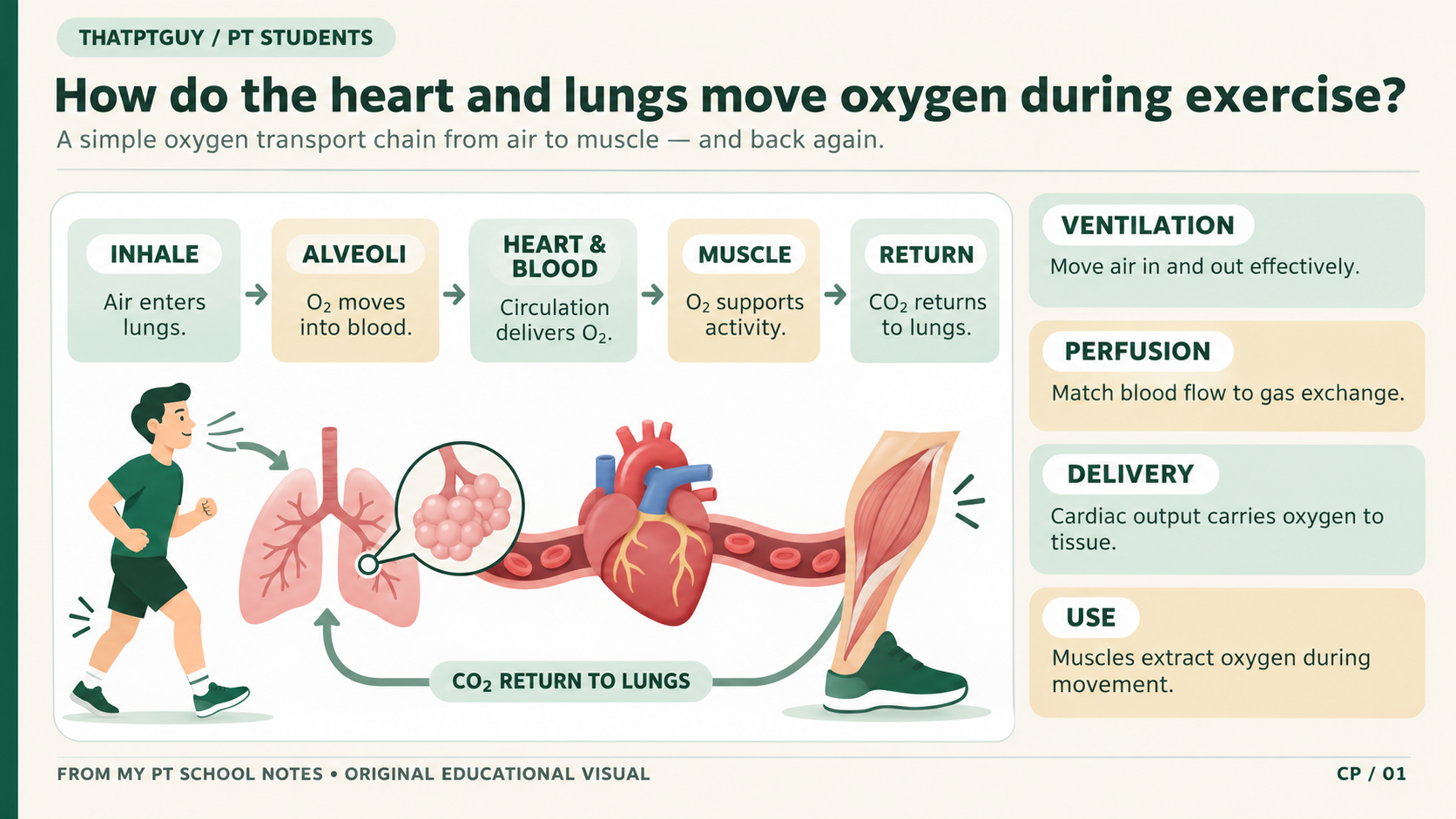
1. Follow the oxygen transport chain
Ventilation moves air into and out of the lungs. At the alveoli, oxygen and carbon dioxide exchange between air and pulmonary capillary blood. The heart then transports oxygenated blood to the tissues, where working muscles extract and use oxygen.
Reduced activity tolerance can reflect problems at more than one point: ventilation, gas exchange, circulation or muscle utilization. A short walking distance does not automatically mean deconditioning.
Can normal-looking breathing frequency prove that gas exchange is adequate?
Reasoning: No. Breathing frequency alone does not describe tidal volume, effective alveolar ventilation, perfusion or oxygenation.
2. Two calculations worth understanding
Minute ventilation = tidal volume × breathing frequency. If tidal volume is 500 mL and respiratory rate is 12/min, minute ventilation is 6 L/min. Estimated alveolar ventilation also subtracts dead space: (500 − 150) × 12 = 4.2 L/min. These are hypothetical examples, not goals for patient breathing.
Cardiac output = heart rate × stroke volume. At 70 beats/min and 70 mL/beat, cardiac output would be 4.9 L/min. The equation helps explain why raising heart rate alone does not ensure more useful circulation.
Do two people with the same heart rate always have the same cardiac output?
Reasoning: No. Stroke volume also matters, and its determinants can vary with condition, activity and medications.
3. Bring physiology back to the task
Observe symptoms, breathlessness, respiratory effort, rate and rhythm when monitored, oxygen saturation with signal quality, blood pressure when appropriate, fatigue, mobility assistance and recovery. SpO2 alone does not describe cardiac output, arterial CO2 or tissue oxygen delivery.
Before choosing more repetitions or distance, ask what limited the activity and whether the response was expected for this person’s current condition.
A patient stops walking because of breathlessness but has good quadriceps strength. Is this automatically an aerobic conditioning problem?
Reasoning: No. Consider cardiopulmonary status and other contributors; reassess and communicate concerning changes before prescribing progression.
Apply it to a clinical situation
The walk that ended early: A patient stands without physical assistance but has to stop after a short walk because of new, marked breathlessness.
What matters most in this situation?
Reasoning: Avoid treating a normal sit-to-stand as proof of safe endurance. Reassess symptoms and available physiologic data and respond to the change before progressing activity.
Common trap: Reducing a complex physiologic limitation to a leg-strength finding.
Source notes & learning scope
Adapted from my cardiopulmonary class notes: Chapters 1–2 and Chapter 16. Original numbers and clinical scenario are educational examples. These are my reorganized class notes with newly written educational examples. This lesson is not a care protocol, official class resource or NPTE guarantee.

