
FROM MY PT SCHOOL NOTES · MUSCULOSKELETAL · CHAPTER 09
Why Does the Shoulder Need Both Mobility and Stability?
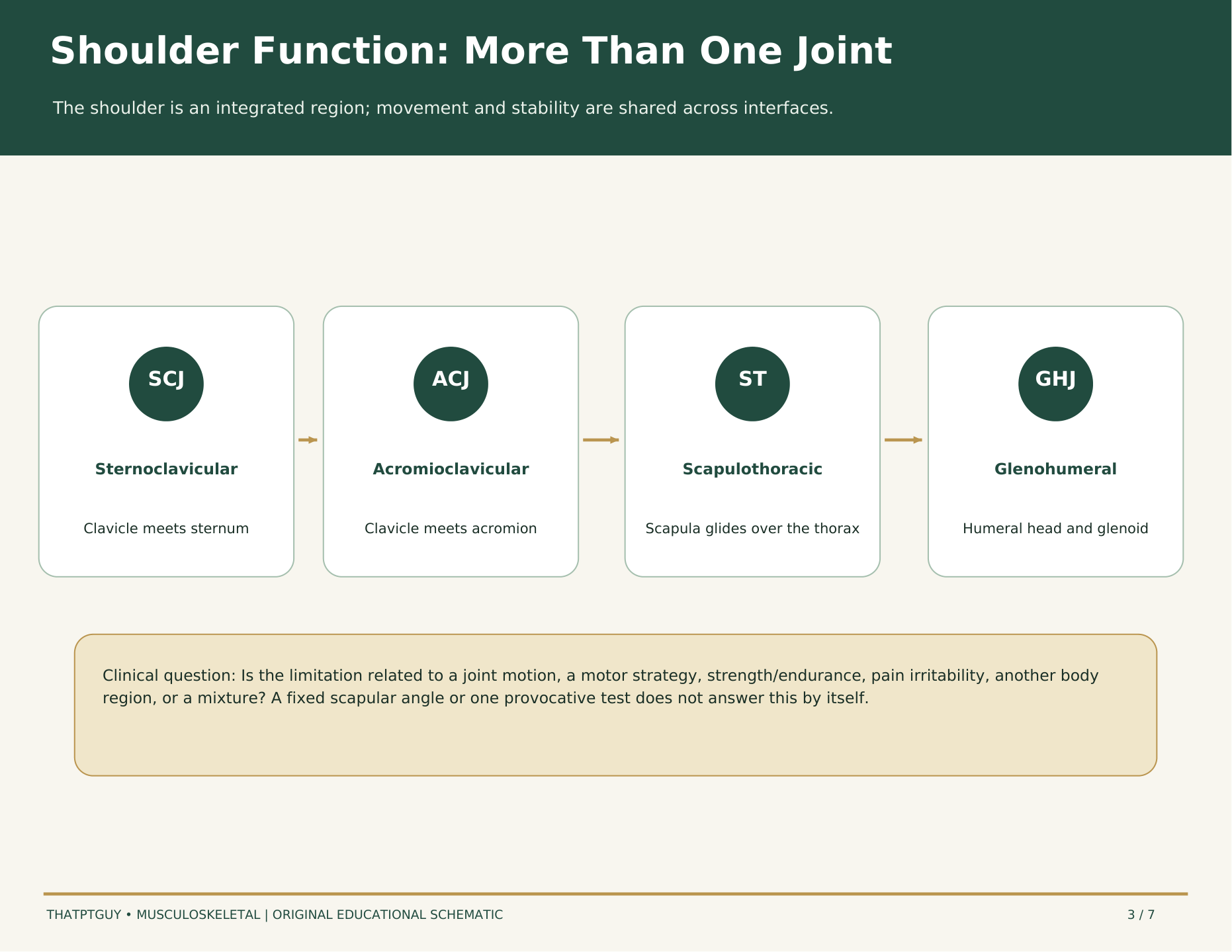
The shoulder is a coordinated joint complex rather than just one ball-and-socket joint. Your arthrokinematics lecture frames it around a balance of mobility and stability.
From the original lecture
The sternoclavicular, acromioclavicular and glenohumeral joints coordinate with scapulothoracic movement. Static articular and capsuloligamentous restraints interact with dynamic cuff, scapular and deltoid muscle control.
How the shoulder lab approaches examination
Begin with history and a relevant cervical screen, then observe actual reaching and carrying. Compare quantity of AROM and PROM, movement quality, familiar symptom provocation and resistance. Follow with selected instability or tissue-loading tests only when history supports their use.
Avoid the single-mechanism trap
A rigid scapulohumeral ratio, one painful arc or one apparent scapular posture does not uniquely identify a lesion. Compare symptom irritability, strength, motion and function rather than assuming that all overhead pain has the same cause.
Try a clinical decision
Full passive shoulder elevation, but markedly limited active loaded reach. Is the capsule necessarily the problem?
No. Explore pain inhibition, strength, cuff/deltoid capacity, neurologic contribution, coordination and task loading. Passive restriction would change the differential, but this comparison alone does not establish one injured tissue.
Original course sources and limitations
Shoulder Arthrokinematics; 1 Shoulder Lab; Shoulder joint-by-joint exercise notes.
This lesson is distilled from my original PT-school notes, with current external guidance labeled separately. It is not an official course or a substitute for clinical examination and procedure-specific protocols.


