
FROM MY PT SCHOOL NOTES · MUSCULOSKELETAL · CHAPTER 21
Ankle Sprains and Chronic Instability: Why Balance Alone May Not Be Enough
Your Foot & Ankle Therapeutic Exercise notes distinguish mechanical laxity, perceived giving-way, copers and recurrent instability. Those categories help build a better rehabilitation decision.
First decide: acute injury or ongoing instability?
Ask about mechanism, time since injury, weight-bearing ability, swelling, bony tenderness, prior sprains and giving-way episodes. Screen for fracture or other injury where indicated rather than assuming that every inversion injury is an isolated ATFL sprain.
Three ligaments, different roles
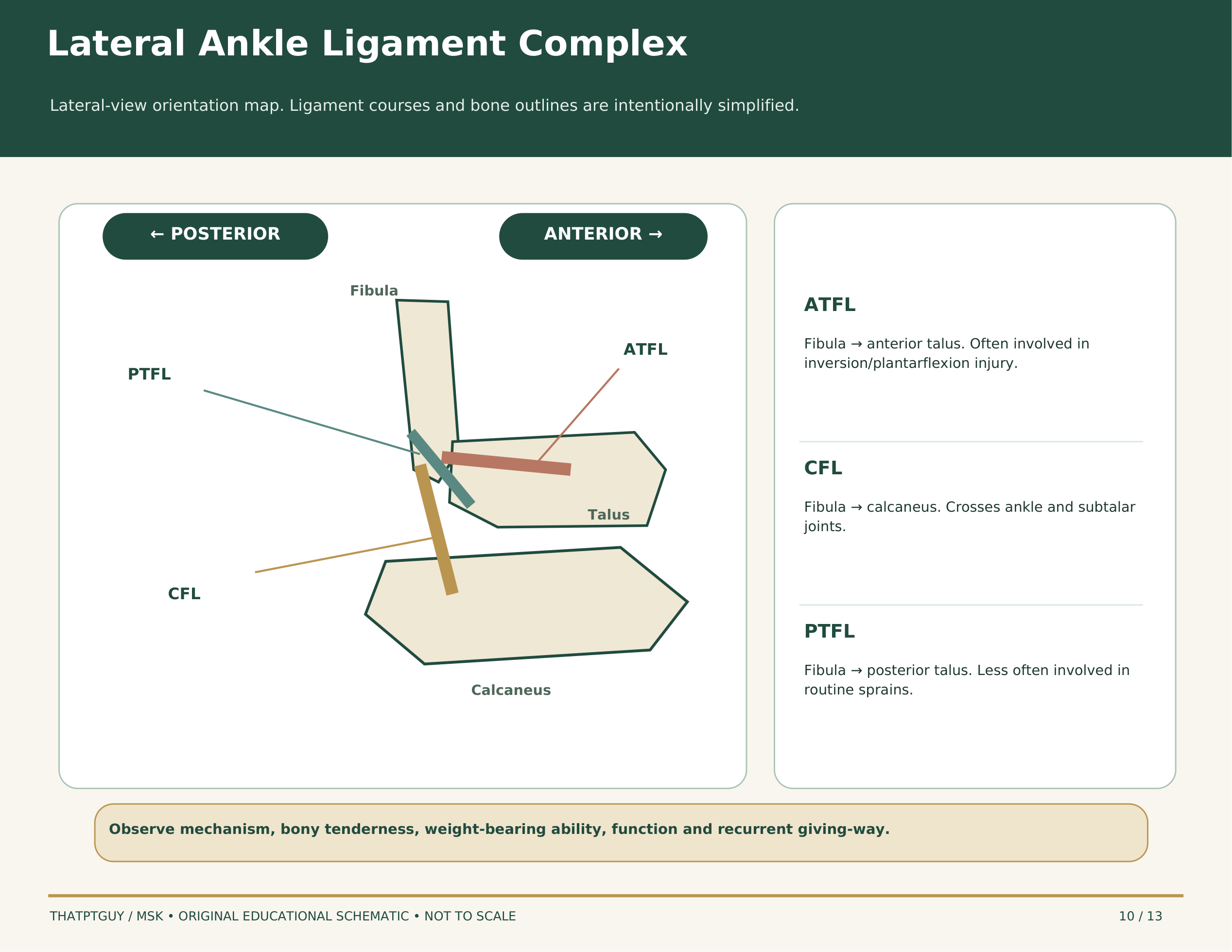
The anterior talofibular ligament (ATFL), calcaneofibular ligament (CFL), and posterior talofibular ligament (PTFL) help resist unwanted motion. In routine lateral sprains ATFL involvement is common; the illustration helps locate the structures, not identify which one is injured.
Why a brace is not the whole program
The 2021 ankle ligament CPG recommends appropriate external support and progressive loading after acute sprain, plus structured ROM, strengthening, balance and neuromuscular training matched to the person. For chronic ankle instability, bracing or taping should not be the only intervention intended to restore balance/postural stability.
Test the sport or work demand
Check weight-bearing dorsiflexion, swelling, safe single-leg balance, dynamic reaching, strength and relevant hopping/cutting performance. Match progression to symptom response and readiness. A stable single-leg stance is not proof of safe reactive landing.
Apply it to a patient
A basketball player reports repeated giving-way during cutting but has little pain and no obvious laxity on a single test. What next?
Consider chronic instability despite a limited stress-test finding. Examine dynamic balance, loaded mobility, strength, confidence and sport-specific lateral control, then prescribe graded functional training and appropriate protection.
Where the material comes from
Foot & Ankle Therapeutic Exercise; Ankle & Foot Lab; Foot & Ankle Pathology; uploaded 2011/2012 instability and proprioception reviews. Later 2021 JOSPT guideline is outside evidence.
Independent class-note companion based on the author’s PT-school learning materials. External references are separately identified. This lesson is not a validated diagnostic algorithm, patient-specific prescription, or an official examination study guide.

