
FROM MY PT SCHOOL NOTES · UNIT 2 · CHAPTER 05
When is knee or hip bracing more appropriate than an AFO?
Knee-ankle-foot and hip-knee-ankle-foot orthoses provide broader control, but added structure can increase weight, energy cost and demands for donning, transfers and sitting.
Recognize the extent of a KAFO
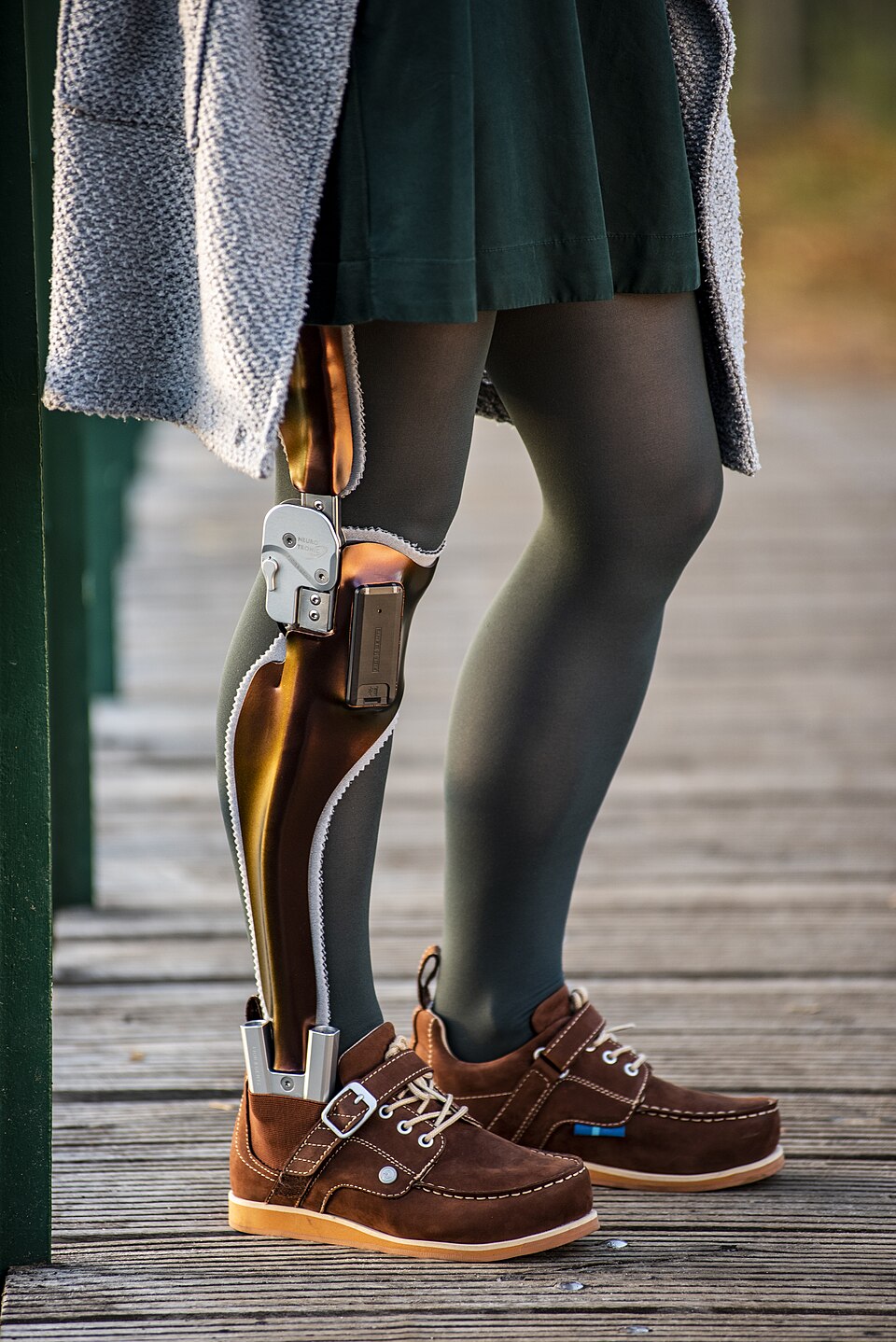
Unlike an AFO, a KAFO spans the knee as well as the ankle and foot. Identify the knee joint mechanism and consider how locking, support and available knee motion could affect standing, swing and sitting.
The key concepts
Identify the stability problem
A KAFO can be considered when knee stability, alignment or control cannot be adequately addressed by less extensive approaches. It may restrict unwanted knee flexion or frontal-plane deviation, but it can also constrain knee flexion that is useful for swing, sitting and obstacle negotiation. A knee-hinged or stance-control feature changes this trade-off.
An HKAFO or reciprocal gait orthosis may be used in selected individuals with substantial proximal deficits and specific rehabilitation goals. Such equipment is not interchangeable with independent community walking, and it often requires assistive devices and considerable training.
Separate demonstration from useful mobility
A person may take steps in parallel bars wearing bilateral long-leg braces yet be unable to put the braces on independently or walk at a useful speed. Evaluate cardiovascular demand, falls risk, upper-limb loading, transfers, toileting, home accessibility and personal motivation. A wheelchair can remain the more functional method for everyday community access.
A less restrictive device that achieves the goal is often preferable, but stability needs and safety take priority over an arbitrary rule to always use the smallest brace.
Plan the interdisciplinary trial
Observe stance knee control, brace locking/unlocking, swing clearance, turns, sit-to-stand, fatigue and ability to recover balance. Document assistance, device and conditions. Review fit and suitability with the orthotist and the patient before long-term prescribing decisions.
Quick comparison
| Knee brace | Targets a knee-specific protection or stability goal |
| KAFO | Adds ankle and knee control; can restrict swing and transfers |
| Stance-control KAFO | Allows selected knee movement with device-dependent constraints |
| HKAFO / RGO | Adds proximal support; high training and energy demands |
Clinical reasoning
A patient safely steps with bilateral KAFOs in a therapy gym but needs maximal help to put them on and becomes exhausted after a short distance. Is walking alone the best outcome measure?
Reasoning: No. Consider full task demands, equipment use, energy cost, transfers and meaningful participation alongside the person’s goals.
Check your understanding
What factors might cause a mechanically successful KAFO to be abandoned at home?
Source lecture(s): 5 Principles of LE Orthoses Part 2.pdf; 4 Principles of LE Orthoses .pdf. Evidence update: Device selection is individualized. Older class claims about exact energy cost and universal candidacy rules require modern context.
These are focused lessons drawn from my PT-school notes, with later guidance identified separately. They are not official coursework, device prescriptions or patient-specific treatment protocols.


