
FROM MY PT SCHOOL NOTES · UNIT 3 · CHAPTER 08
How do we know the orthosis is helping in real life?
Successful orthotic management is an ongoing process: fit, train, observe, measure and revise. A device can achieve its mechanical aim yet still fail the patient’s daily-life goal.
The key concepts
Reassess the whole person-device-environment system
Document what changed compared with the pre-device condition: foot clearance, support, balance, pain, endurance, skin safety and the individual’s ability to use the orthosis. Check actual footwear, brace alignment, strapping, comfort, stairs, ramps, work surfaces and mobility equipment. Pain or skin irritation after fitting is feedback to investigate, not a sign to push through.
A child’s body and goals change with growth, while an adult may change through recovery, disease progression, work demands or changes in activity level. Any device prescription needs a follow-up pathway.
A practical fitting and reassessment loop
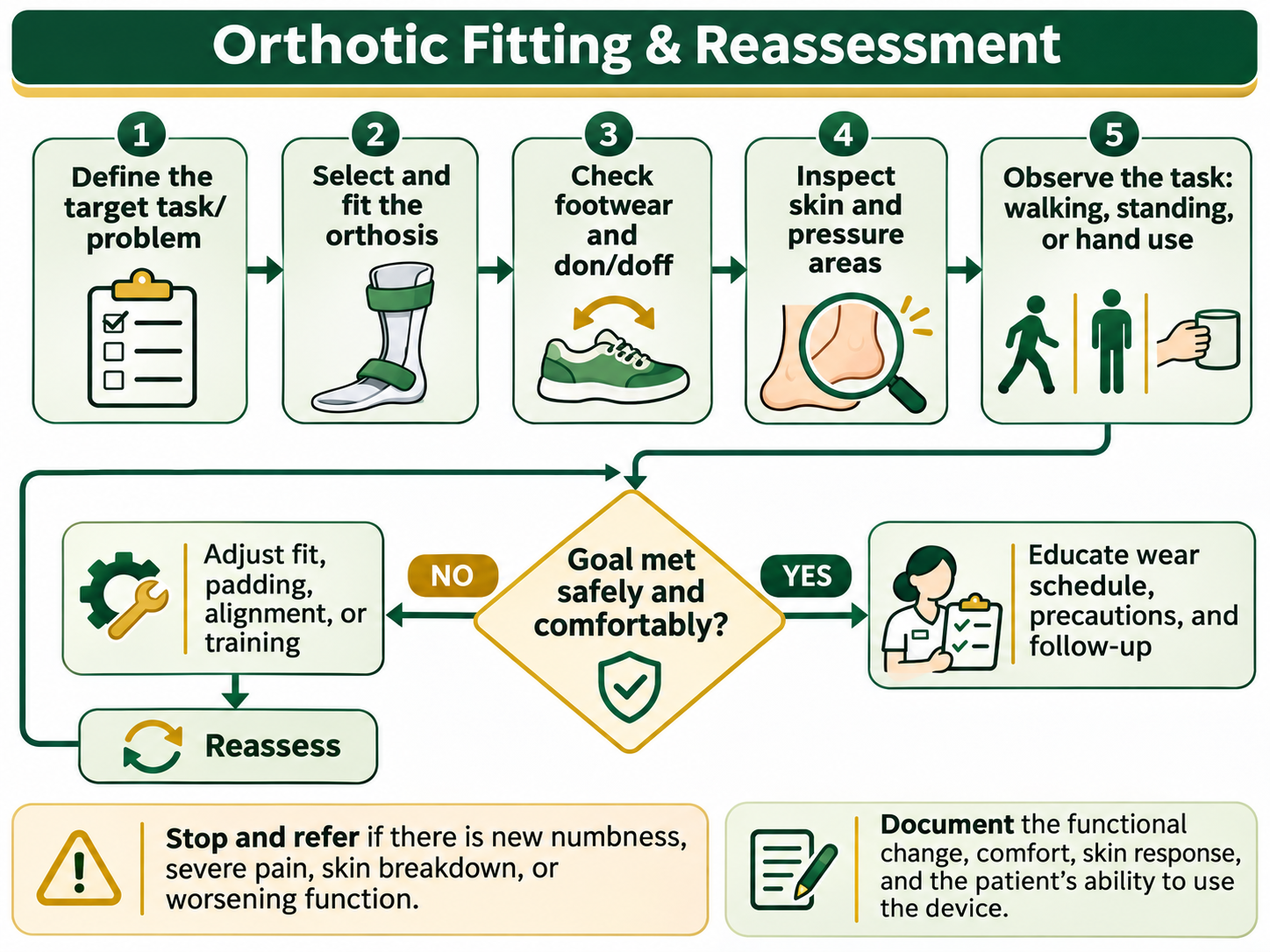
Use this as a general workflow, not a fixed protocol: footwear checks apply chiefly to lower-extremity devices; upper-limb and spinal orthoses have their own task-specific and medical precautions. Persistent pain, skin breakdown, new neurologic changes or worsening function warrant prompt review, not simply continued adjustments.
Match an outcome to the claimed benefit
AFO clearance goal: observe toe catch, trips, timed mobility or relevant task success. Knee stability goal: observe episodes of buckling, transfers and walking on meaningful terrain. Foot-pressure or pain goal: track symptoms, skin response and functional activity. Spinal protection goal: verify medical restrictions and safe daily task strategies rather than equating tightness with protection.
Gait speed can be useful but may conceal new effort, painful pressure or reduced confidence. Use a combination of appropriate objective and patient-reported measures.
Know when the device is not the answer
A brace should complement rehabilitation when appropriate, not automatically replace strength, balance, graded exposure, footwear education, tissue protection or medical care. Referral may be needed for wound risk, new neurologic deficit, poor mechanical alignment, progressive deformity, new breathing problems or problematic pressure.
Work with the patient and orthotist to revise the design or activity plan as needed. Returning for an adjustment is part of good care, not failure.
Quick comparison
| Mechanical effect | Did it change the intended joint or segment behavior? |
| Activity effect | Does the person complete the target task more safely? |
| Tolerability | Skin, pain, comfort and donning ability |
| Participation | Does it help with work, home or community goals? |
Clinical reasoning
A patient walks faster in the clinic with an AFO but cannot drive the adapted foot control or don the brace without help. Is the faster 10mWT sufficient evidence the device is optimal?
Reasoning: No. Safety, self-management, transport and life goals must be part of the selection and follow-up.
Check your understanding
Name three findings that should prompt orthotic adjustment or reconsideration rather than more gait repetitions.
Source lecture(s): 1 Intro.pdf; 3 Foot Orthotics.pdf; 4–5 Principles of LE Orthoses; 6 Spinal Orthoses.pdf; 7 Hand Orthoses.pdf. Evidence update: Synthesis chapter written independently from the source concepts, with contemporary AFO/FES and heel pain guidance where applicable.
These are focused lessons drawn from my PT-school notes, with later guidance identified separately. They are not official coursework, device prescriptions or patient-specific treatment protocols.

