
CHAPTER 3 · FROM MY PT NOTES
Strength, endurance or power?
“We’re strengthening it” leaves a lot unanswered. Do we need more force, more repeated effort, or the ability to produce force quickly? That distinction helps you decide what the exercise should look like.
1. What kind of improvement do we need?
| Emphasis | Exercise example | What you would consider |
|---|---|---|
| Strength | Progressively loaded seated knee extension | Resistance, effort, range and enough rest to preserve the intended performance. |
| Endurance | Repeated heel raises with stable support | Repeated-task demand, amount of work, fatigue and recovery. |
| Power | An appropriately supervised, brisk chair rise | Intent to rise quickly with control, suitable resistance and adequate recovery. |
| Hypertrophy | Progressive knee-extension or leg-press training | Accumulated training volume, effort, progression and recovery. |
Don’t get too hung up on putting every rep count into a perfect box. These adaptations overlap. Lower loads can improve strength, too. Use the goal to guide your choices rather than assuming repetition number alone tells you what you trained.
2. What do concentric, eccentric and isometric mean?
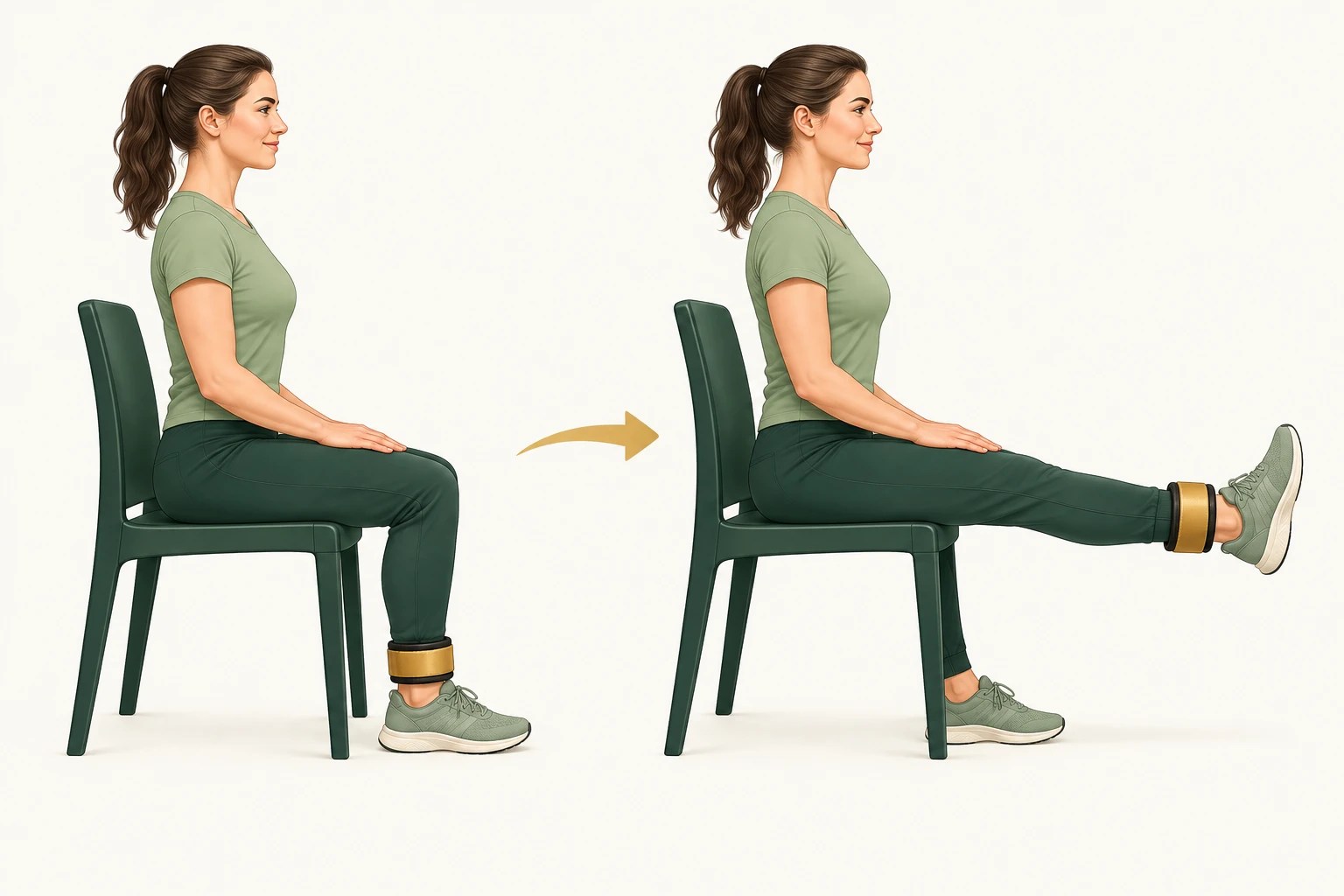
Here’s the part worth slowing down for: name the muscle, then ask what it’s doing against the resistance. The knee bends as the weight comes down, but the quads can still be doing the work by controlling that lowering. A hold isn’t automatically easier or safer just because the joint stays still.
Okay, but what does that help them do?
If we’re building quad strength to help with stairs, let’s keep stairs in the picture. Work toward the step height, number of steps and support the patient needs. The cuff weight can increase when appropriate, but it isn’t our finish line.
3. Five pounds isn’t the same challenge for everyone
Load is the resistance you give them. Effort is how demanding it feels to them. Five pounds can be easy for one patient and plenty for another. You need both pieces of information.
RPE means rating of perceived exertion. RIR means repetitions in reserve: an estimate of how many additional repetitions could be performed. Both need explanation and practice; neither replaces observation, precautions or clinical assessment.
Show the math: what does 70% of 1RM mean?
1RM is the greatest load lifted once for a specified exercise under specified conditions. If that value is 40 lb, 70% is 40 × 0.70 = 28 lb. That is arithmetic—not proof that 28 lb is appropriate for a patient. Estimates carry uncertainty, and a value from one exercise does not transfer to another. Maximal testing is not required for every rehabilitation plan.
4. Does the program need to be complicated?
The 2026 ACSM review supports many resistance-training approaches for healthy adults. Heavier loading can favor maximal-strength gains; higher weekly volume can favor muscle growth; movement intent and suitable loading matter for power. Training to failure and complicated routines are not prerequisites for every useful program.
Apply those findings within the population studied. An injured person’s restrictions, tolerance and functional goals may require a different starting point. Equipment is a means to create a suitable demand—not a ranking of “functional” versus “nonfunctional” exercises.
Quick check: rising slowly from a chair is easy, but getting up promptly is difficult. What else might matter?
Rate of force production and task coordination may be relevant alongside strength. Assess the task before adding speed. Power-oriented practice is a possible choice when appropriate, not a universal instruction to move faster.
Quick check: lowering the ankle weight is eccentric work for which muscle group?
The quadriceps, when they control knee flexion as gravity lowers the leg. The knee bends, but that does not mean the hamstrings are necessarily the primary muscles producing the controlled lowering.
What I’d want you to remember: decide what needs to improve, pick a useful challenge, and keep checking whether it helps the person do what matters to them.
Practice this chapter · 3 questions
Sources & learning scope
Original explanation informed by my Therapeutic Exercise class materials: 5 Resistance Exercise (muscular fitness, contraction types, loading and assessment) and 2 Assessment and Prescription. Updated against the 2026 ACSM resistance-training position stand and APTA guidance on interventions, response and functional progress. Healthy-adult training evidence is not an individualized rehabilitation protocol. Examples assume assessment and precautions support the activity. Published October 29, 2026.

