
CHAPTER 2 · FROM MY PT NOTES
When should I make an exercise harder?
The exercise looks easy. Do you add weight? More reps? A foam pad? I’d start with a different question: what is still keeping this person from their goal? Then check whether their performance and recovery support the next step.
1. Harder in what way?
Overload means giving the system more challenge than it is used to. Progressive overload means adjusting that challenge as ability changes. The important part: know what you’re asking for more of.
Adding a foam pad changes the exercise, sure. But did we need more balance challenge? If the goal is strength, make sure the change still lets you train strength.
The goal isn’t a heavier ankle weight
If the patient wants to use the stairs, we need to work toward the stairs. Strength work can help along the way. Keep asking which part of the real task they’re ready to practice next.
| Patient’s goal | Possible path toward it |
|---|---|
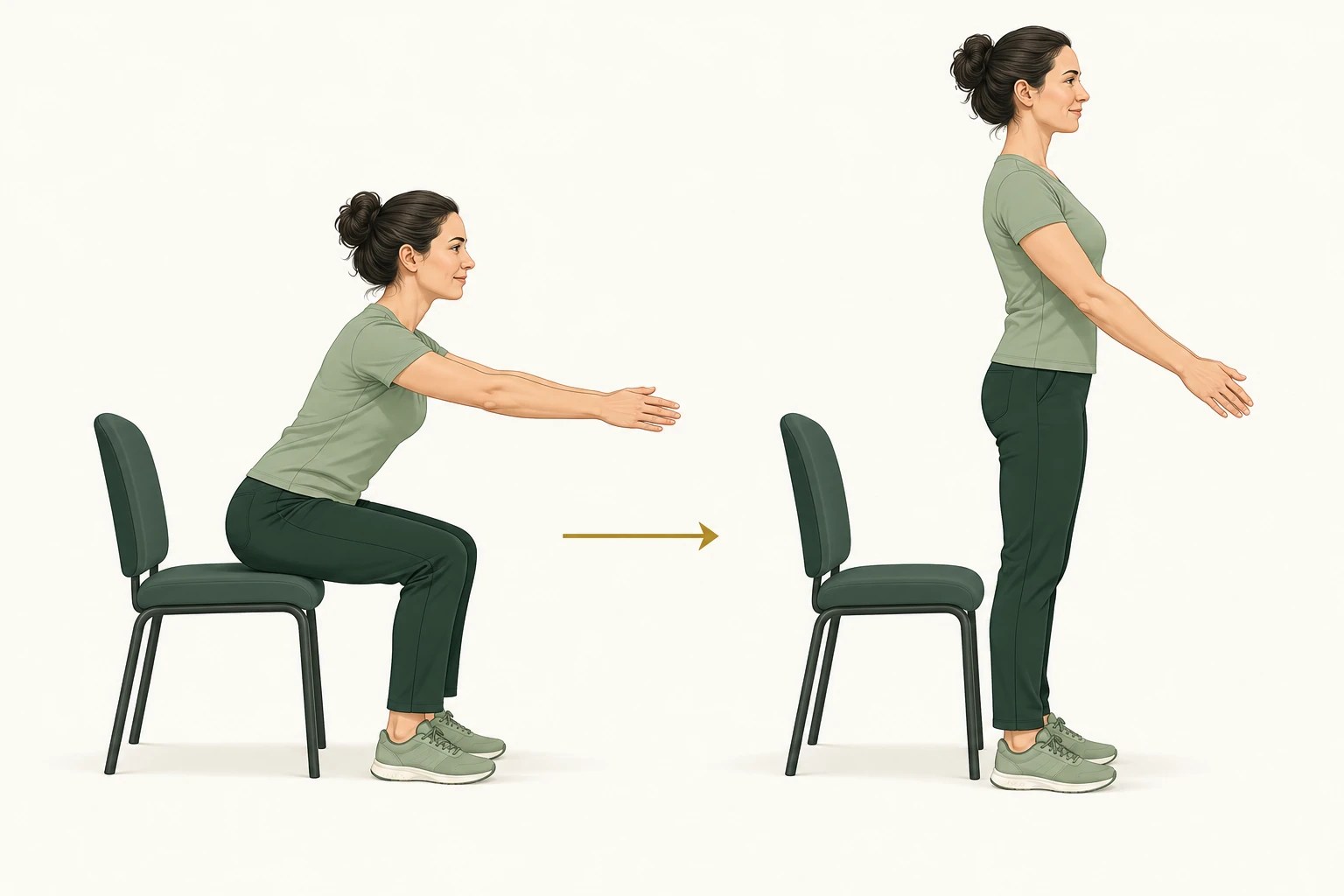
| Rise from the sofa | Higher-seat chair rise with needed support → practice at the relevant lower seat height → repeat under the conditions needed at home. Keep support when it remains useful or necessary. |
| Put dishes away | Supported reaching as needed → reach to the target shelf → place a manageable object → work toward the actual object and repetitions. |
| Lift and carry a child | Lift a manageable box from a raised surface → lower the starting height → practice carrying and turning → work toward the required load and distance. Use a simulated load while learning. |
| Manage the home stairs | A manageable step with a rail → relevant step height → repeated steps or a flight with needed support. Match ascent or descent to the goal. |
These are examples, not mandatory ladders. Choose the starting point and next demand from assessment, precautions, safety and response. Do not remove a rail or add balance complexity just to make an activity harder.
Progression options: task range or height, assistance, repetitions, carry distance, direction changes, speed when relevant, and load. Select the variable that addresses the remaining task demand.
2. Progress, hold or regress?
Before making it harder, check how they moved, the help needed, effort, symptoms during the exercise and recovery afterward. Also ask what they actually completed at home. A plan on paper and a plan someone can do aren’t always the same thing.
Example: a patient can rise easily from a high clinic chair but still struggles with the lower sofa at home. Trial an appropriate reduction in seat height while keeping needed support and the amount of practice consistent. Recheck performance and recovery. Add load if force remains a limiting demand; do not let a heavier clinic exercise substitute for practicing the home task.
If performance deteriorates, consider reducing load, raising the seat, allowing more rest or reducing the amount. New or worsening symptoms require reassessment; do not automatically label every poor response “normal soreness.”
3. What if progress stalls?
| Principle | What it means in practice |
|---|---|
| Specificity | Train the capacity or activity you want to improve. |
| Individual variation | The same program can produce different responses. |
| Diminishing returns | Early gains may be easier to obtain than later gains. A plateau is a reason to review the plan. |
| Recovery | More work is not always more useful. Account for rest, sleep and other demands. |
| Reversibility | Some gains can decline when training is reduced or stopped; the amount and timing vary. |
Quick check: an exercise is harder because you added a foam pad. Is that progressive strength training?
Not necessarily. You changed the balance and task demands. To justify it, explain which goal that change serves. For strength, consider whether the target muscles are receiving an appropriate loading challenge.
Quick check: the patient completed every repetition but needed much more help. Progress?
Not on rep count alone. Assess assistance, movement, effort, symptoms and recovery. The completed number may conceal a demand that was too high.
What I’d want you to remember: make the next step useful. A harder exercise only helps if that challenge serves the patient’s goal.
Practice this chapter · 2 questions
Sources & learning scope
Original explanation informed by my Therapeutic Exercise class materials: 2 Assessment and Prescription and 5 Resistance Exercise. Updated against the 2026 ACSM resistance-training position stand and APTA guidance on interventions, response and functional progress. Healthy-adult training evidence is not an individualized rehabilitation protocol. Examples assume assessment and precautions support the activity. Published October 29, 2026.

