
CHAPTER 1 · CHOOSING & PRESCRIBING EXERCISE
Give every exercise a job
Knowing a list of exercises is one thing. Knowing which one to pick is where it gets tricky. Here’s how I’d break it down: what are we trying to help this person do, and how does this exercise get them there?
1. What are we actually trying to help?
Let’s use something simple: getting out of the dining chair without pushing through the arms. Your assessment suggests the quads aren’t producing enough force. Now you have a reason to consider these two exercises.
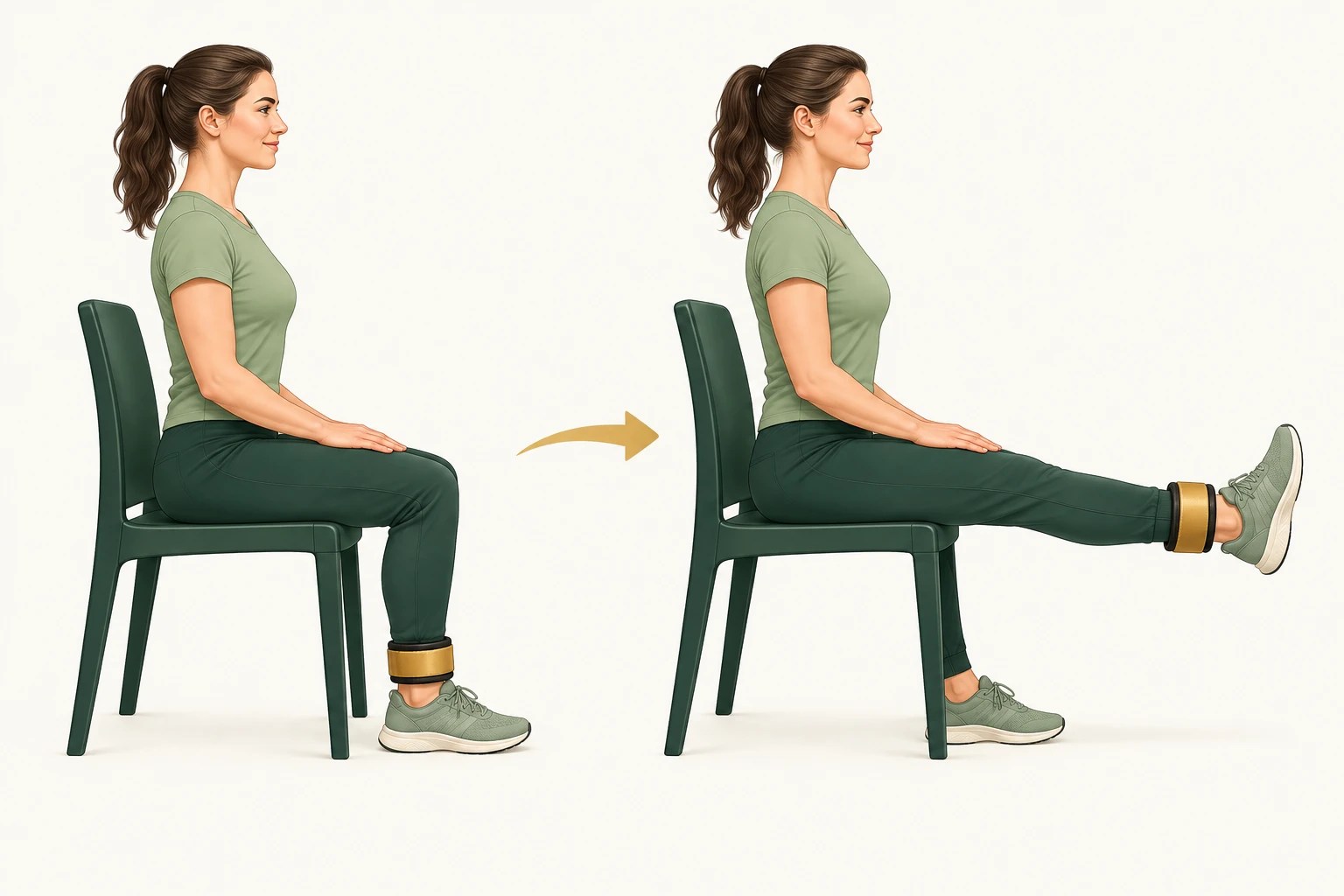
Build capacity · seated knee extension
Seated knee extension gives you a way to work on quad strength when the whole chair rise is too demanding. That’s its job. Choose resistance and range the person can manage within their precautions.
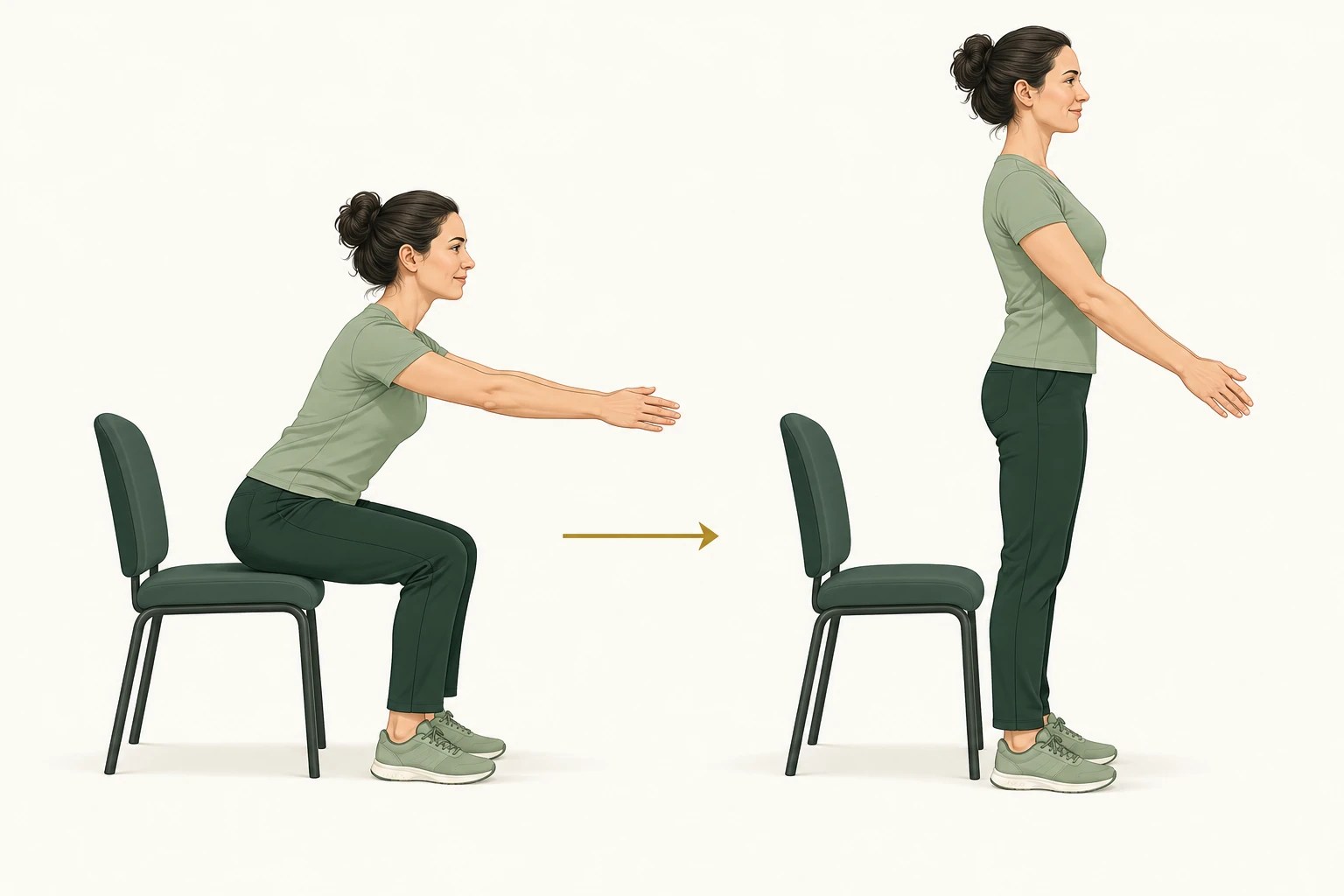
Practice the task · sit-to-stand
Then practice getting up. Start from a higher stable chair or allow arm support if needed. The patient gets to practice the forward weight shift and leg effort together—something knee extensions alone won’t teach.
Why both? The knee extension has a purpose, and so does the chair rise. As things improve, work toward the actual chair and the help they need at home. I want the patient getting off the sofa—not just getting better at lifting an ankle weight.
2. Why are we doing 3 sets of 10?
Three sets of ten might be fine. But why ten? If we can’t explain the resistance, effort, rest and frequency, we haven’t finished prescribing the exercise.
One patient cruises through ten knee extensions. Another starts struggling at four. Writing “3 × 10” for both doesn’t make the challenge equal. Watch what happens, ask how it feels, and adjust the load, range, rest or amount.
For knee extension, record resistance, sets, repetitions and rest. For sit-to-stand, also record seat height and arm support. Monitor effort, symptoms and recovery to decide whether to maintain or adjust the plan.
Quick check: ten repetitions feel easy. Always add more?
No. Confirm the goal first. You might increase resistance for a strength emphasis or adjust repetitions for an endurance emphasis. Neither choice is automatic, and adaptations overlap. Consider technique, precautions and recovery.
3. Great, they’re stronger. Can they get up?
Check the strength, then check the chair rise. A better strength number is progress. I still want to know whether getting up is easier.
Compare assistance, effort, symptoms and confidence under consistent conditions. Then check the real setting: a low sofa or repeated chair rises may demand more than one rise from a high clinic chair.
Quick check: strength improves, but chair rising does not. What next?
Reassess the task. Remaining demands may include coordination, symptoms, confidence, endurance or the seat setup. More resistance may help, but it is not automatically the next step. Immediate changes inform your reasoning; they do not prove a cause.
What about the shoulder?
Shelf reaching: if limited shoulder elevation is relevant, supported reaching or wall slides may help practice motion. Recheck reaching at a meaningful shelf height and load—not ROM alone.
Before you add an exercise, try saying this: “I chose ___ to address ___ so the patient can ___. I will recheck ___.”
Extra context: what can change the plan?
A diagnosis alone does not select an exercise. Findings, task demands, patient preferences, time, equipment and precautions all matter. Assess nearby joints when there is a relevant reason; proximity alone does not justify treatment. These are educational examples, not complete rehabilitation protocols.
Sources & learning scope
Original synthesis informed by my class materials: 2 Assessment and Prescription (assessment, specificity, prescription and adherence) and 3 Functioning and Disability (function, context and patient management). Course slides and figures are not reproduced.
WHO: ICF framework · APTA: linking interventions, response and functional progress. AAOS: knee conditioning exercise reference (knee-extension example; dosage is individualized here). ACSM 2026 resistance-training position stand: goal-specific programming and individualization in healthy adults; not a rehabilitation protocol. The reasoning sequence is a teaching synthesis, not a validated clinical decision rule.
Published October 29, 2026. Student education, not an individualized treatment plan. Apply clinical skills within supervision, current precautions and the established plan of care.

